

4月16日的Analytical Chemistry应用程序分析
Analytical Chemistry
- RK Technologies
- Google Play 商店
- 免费
- 教育
The material covers both fundamental and practical aspects of chemical analysis. There are 7 major Parts to the app that follow the brief introduction in Chapter 1.
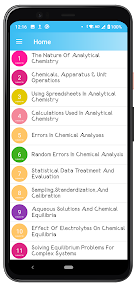
• Part I: covers the tools of analytical chemistry and comprises seven chapters. Chapter 2 discusses the chemicals and equipment used in analytical laboratories. Chapter 3 is a tutorial introduction to the use of spreadsheets in analytical chemistry. Chapter 4 reviews the basic calculations of analytical chemistry. Chapters 5, 6, and 7 present topics in statistics and data analysis that are important in analytical chemistry. Chapter 8 provides details about acquiring samples, standardization, and calibration.
• part II: covers the principles and application of chemical equilibrium systems in quantitative analysis. Chapter 9 explores the fundamentals of chemical equilibria. Chapter 10 discusses the effect of electrolytes on equilibrium systems. The systematic approach for attacking equilibrium problems in complex systems is the subject of Chapter 11.
• part III: brings together several chapters dealing with classical gravimetric and volumetric analytical chemistry. Gravimetric analysis is described in Chapter 12. In Chapters 13 through 17 includes acid/base titrations, precipitation titrations, and complexometric titrations.
• part IV: is devoted to electrochemical methods. Chapter 18,19 describes the many uses of electrode potentials. Chapter 20, Chapter 21 presents the use of potentiometric methods to measure concentrations of molecular and ionic species. Chapter 22 considers the bulk electrolytic methods of electrogravimetry and coulometry, and Chapter 23 discusses voltammetric methods.
• part V: presents spectroscopic methods of analysis. The nature of light and its interaction in Chapter 24. Spectroscopic instruments and their components are the topics covered in Chapter 25. The various applications of molecular absorption spectrometric methods are in Chapter 26. Chapter 27 is concerned with molecular fluorescence spectroscopy. Chapter 28 covers atomic spectrometric methods. Chapter 29 on mass spectrometry provides an introduction to ionization sources, mass analyzers, and ion detectors.
• part VI: includes kinetic methods of analysis in Chapter 30. Chapter 31 introduces analytical separations including ion exchange and the various chromato graphic methods. Chapter 32 discusses gas chromatography, while high-perfor- mance liquid chromatography is covered in Chapter 33. The final chapter in this Part, Chapter 34, introduces some miscellaneous separation methods.
👉Features of the application
✔ Chapter-wise Reading
✔ This Application Is Useful To Students and Teachers
✔ Save Memory
✔ Full screen reading, Night mode reading
✔ Offline Reading Facility
✔ Zooming Facility
✔ Bookmark important page
Analytical Chemistry 使用排名
使用率排名基于 Similarweb 的算法,该算法会计算 28 天内的当前安装量和活跃用户数。
所有品类在
美国--
教育在
美国--


 Analytical Chemistry VS.
 四月 16, 2026