

Word Family Games vs Is that Silly? Usage & Stats
Word Family Reading Games are fun and educational.
Children who play the 132 games can learn to read, build their vocabularies,
and acquire phonics and spelling skills. Each game (matching, spelling,
Bingo) is slightly different every time it is played. Children as young as four
will become early readers. Older children will master essential reading
skills.
The games make acquiring or enhancing reading skills easy because they use
the educationally sound word family approach of rhyming words (hat, bat,
cat, mat). The early games are for teaching children to read. Then they
slowly introduce the acquisition of more advanced reading skills.
- Apple App Store
- Paid
- Education
Store Rank
- -
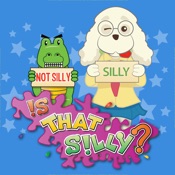
Is That Silly is a fun way to teach children of various ages to pay attention to detail and expand their language skills. Designed with over 120 pictures created specifically to attract children’s attention, Is That Silly helps develop both receptive and expressive language as well as encouraging visual and auditory attention. The high-quality images in Is that Silly come in pairs, one silly and one “not silly” and are presented randomly. Each non-silly picture represents an every-day or true-life situation. The matching picture will vary by a silly change in wording.
How to play
With each turn, a narrator describes what is happening in the picture (e.g., “He is wearing his shoes on his hands.”). The student then selects the “silly” or “not silly” image. If the correct image is tapped, the child is congratulated. If the “silly” image is tapped correctly, the app automatically moves forward to the expressive feature and the child is asked what makes the picture silly. The adult working with the child then makes the judgment on if the child’s answer was “correct,” “almost correct,” or “not correct.” The correct/incorrect responses are marked by tapping on one of three flowers placed discretely in each scene. A “next” arrow is present on every page so the scene can be skipped if necessary. A tally of correct responses is tucked discretely in the corner of each scene.
Customization
Is that Silly is customizable from both the opening screen and inside each scene. The adult can choose if there are verbal/written prompts and verbal rewards. In addition, if the student is not ready for the expressive component, the prompt to explain why a picture is silly can be turned off. At the end of the session, a report card is generated indicating how the student has done. This report card can be emailed, or printed from the app. Although the default is for the percent correct score to show in each scene, this can be turned off by the adult.
Purpose
The purpose for Is That Silly is to encourage language growth. Children with ADHD, Autism, language disorders, and various learning disorders often struggle to attend to details1. Is That Silly allows the parent, SLP, or teacher to teach the expressive and pragmatic language skills many of these children are lacking. When the adult continues asking questions about the picture, the student is encouraged to expand language skills2. Because the app is fun and creative the students will be motivated to see what happens on the next picture.
Is That Silly has the following features
•High-quality images that will capture the attention of the student.
•Receptive language building by encouraging students to listen to the description.
•Expressive language building through answering “wh” questions and discussing the pictures.
•Visual/auditory discrimination forcing students to attend to both the visual and auditory cues.
•Data collection for each student.
•Compatible with Therapy Report Center for easy report writing and progress monitoring.
•Customizable to fit therapy needs
Sources:
1https://sites.google.com/a/pluk.org/pluk-notes-autism/characteristics-interventions-supports/communication-language
2Yoder, Davies, Bishop, Munson (1994) Effect of adult continuing wh-questions on conversational participation in children with developmental disabilities Journal of Speech and Hearing Research Vol 37, 193-204.
- Apple App Store
- Paid
- Education
Store Rank
- -
 Word Family Games VS.
  Is that Silly?
January 14, 2026