


 Sales Intelligence
Why Your B2B Lead Generation Strategy Fails: The MQL-SQL Gap And 8 Fixes That Work in 2026

TL;DR
B2B lead generation fails when marketing generates volume without sales qualification criteria. The MQL-SQL framework separates marketing-qualified leads (engaged prospects) from sales-qualified leads (ready to buy). Successful 2026 strategies combine precise ICP definition, intent data, content aligned to buyer journey stages, and sales-marketing alignment on lead scoring. Similarweb Sales Intelligence automates qualification using behavioral signals.
Your lead generation numbers look impressive in the dashboard. Marketing delivered 500 new leads last quarter. But when sales follow up, 80% go nowhere. The leads aren’t ready. They don’t match your ICP. They ghost after the first call.
This isn’t a sales execution problem. It’s a lead generation strategy problem. Specifically, it’s the MQL-SQL gap: marketing optimizes for volume (marketing-qualified leads), while sales needs buying intent (sales-qualified leads). Without a shared framework for what constitutes a qualified lead, you’re burning budget on contacts who will never convert.
According to HubSpot’s 2025 State of Marketing Report, only 61% of B2B marketers say their lead generation efforts effectively support sales goals. Research consistently shows that misaligned sales and marketing teams generate substantially higher cost per acquisition and lower pipeline conversion, a problem that compounds at scale.
Drawing on Similarweb Sales Intelligence data across 500+ B2B SaaS accounts, this article introduces the MQL-SQL framework as the foundation for modern B2B lead generation, then provides eight tactical fixes, from ICP precision to intent data to sales-marketing alignment, that close the gap and drive measurable pipeline growth.
Understanding the MQL-SQL framework: why lead quality beats lead volume
Marketing-qualified leads (MQLs) are prospects who have engaged with your content (downloaded a whitepaper, attended a webinar, visited your pricing page) but haven’t yet demonstrated buying intent. Sales-qualified leads (SQLs) meet specific criteria indicating they’re ready for a sales conversation: budget confirmed, decision-maker identified, timeline defined, and a clear business problem your solution solves.
The MQL-SQL framework creates a shared language between marketing and sales. Marketing’s job is to generate MQLs efficiently. Sales development’s job is to qualify MQLs into SQLs. Sales’ job is to close SQLs. When each team optimizes for their stage without alignment, the handoff breaks.
The traditional approach vs. the MQL-SQL approach:
| Traditional lead gen | MQL-SQL framework |
| Marketing measures lead volume | Marketing measures MQL to SQL conversion rate |
| Sales receives all leads | Sales receives only SQLs |
| No shared qualification criteria | Explicit scoring model (BANT, MEDDIC, etc.) |
| Sales complains leads are “bad” | Sales and marketing co-own qualification |
| Attribution is unclear | Clear pipeline contribution by stage |
Source: Similarweb Sales Intelligence analysis, 2024.
The MQL-SQL framework doesn’t reduce lead volume. It increases qualified lead volume by focusing marketing spend on prospects who match your total addressable market (TAM) and exhibit buying signals.
1. Define your ICP with precision: revenue, tech stack, and behavioral signals
Your ideal customer profile (ICP) is the foundation of lead qualification, and the precision of that profile dictates the precision of every downstream activity. A vague ICP (“mid-market SaaS companies”) produces a prospect list so broad that sellers spend most of their week chasing accounts that will never sign. A precise ICP: “B2B SaaS companies with $10M to $50M ARR, running Salesforce and HubSpot, with 20%+ month-over-month traffic growth and active sales hiring” produces a list where almost every name has a credible reason to buy now. The reason this matters to a seller is brutal arithmetic: closed-won analysis from Forrester shows that reps prospecting against a tightly defined ICP convert at roughly 2 to 3 times the rate of reps working from generic firmographic lists, because every minute spent on a poor-fit account is a minute not spent on a good one [Source: Forrester, The State of Account-Based Marketing, 2024].
Modern ICP definition goes beyond firmographics for the same reason that modern credit scoring goes beyond income: behavior is more predictive than category. Revenue and growth signals (funding stage, headcount growth, traffic trends) tell you whether a company can afford you and is in a buying posture. The technology stack tells you whether you’ll fit in their environment and where their budget is already flowing. Behavioral signals such as new hires in sales-ops roles, repeated visits to competitor comparison pages, and surges in solution-category content consumption tell you they’re already in market. Organizational structure (decision-maker titles, buying-committee size) tells you whether one champion can move the deal or whether you’ll need to navigate a six-person committee.
Similarweb Sales Intelligence’s Lead Generator operationalizes this at scale by letting reps filter the entire universe of companies by revenue estimates, traffic volume and trend, technology stack (via Similartech), engagement metrics, and geography in a single query. The practical effect is that a rep can build a 200-account weekly target list grounded in real signals in roughly 15 minutes, work that previously required a junior researcher and several days.
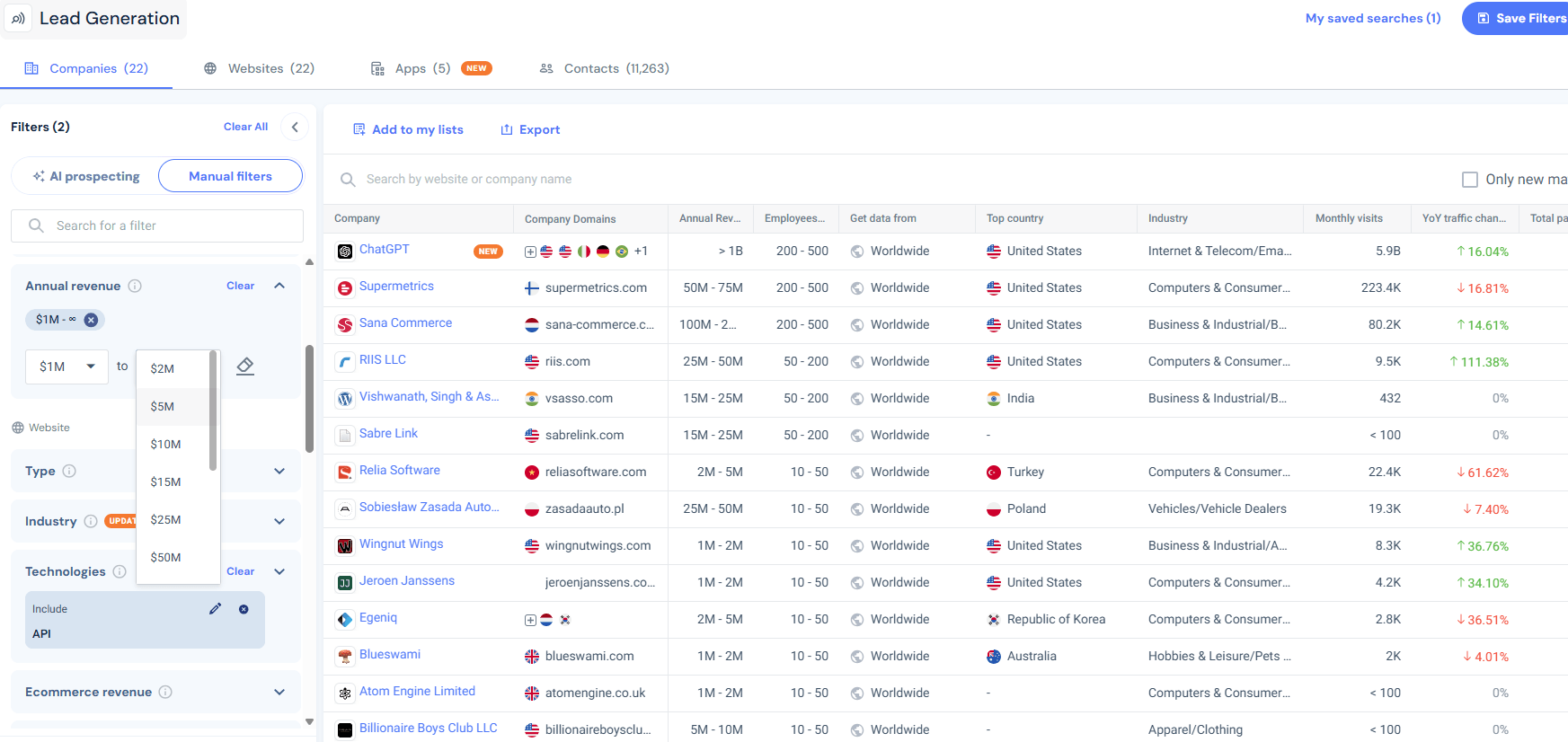
Action step: Document your ICP in a one-page template shared between sales and marketing, and write the disqualification criteria explicitly (company types you will not pursue). Update the document quarterly based on closed-won analysis, because the only ICP that stays accurate is one re-anchored to recent wins.
2. Map content to the buyer’s journey: awareness, consideration, decision
B2B buyers move through three stages before purchase: Awareness (identifying a problem), Consideration (evaluating solutions), and Decision (selecting a vendor). Lead generation content must map to each stage, with different CTAs and qualification thresholds.
Buyer’s journey content framework:
| Stage | Buyer mindset | Content types | Lead qualification |
| Awareness | “We have a problem” | Blog posts, industry reports, educational webinars | MQL (email capture) |
| Consideration | “What solutions exist?” | Comparison guides, case studies, product demos | MQL to SQL transition |
| Decision | “Which vendor do we choose?” | ROI calculators, free trials, vendor comparisons | SQL (sales-ready) |
Source: Demand Gen Report 2024 Content Preferences Study.
Most B2B companies over-index on Awareness content (blog posts, SEO) and under-invest in Decision content (ROI calculators, comparison pages). This generates top-of-funnel traffic but few SQLs.
Action step: Audit your content library by buyer stage. Aim for a 40% Awareness / 40% Consideration / 20% Decision split. Gate Decision-stage content aggressively. These are your highest-intent leads.
3. How does intent data help identify in-market B2B buyers before they contact you?
The single largest hidden cost in B2B sales is calling on accounts that aren’t ready. Intent data is the antidote: rather than waiting for a prospect to fill out a form (a lagging indicator that surfaces, on average, only after they’ve already shortlisted vendors), intent data captures the behavioral signals that reveal active research weeks earlier: search queries in your solution category, third-party comparison-site visits to G2 and Capterra, sudden spikes in your own website traffic from a single domain, and technographic changes such as a competitor being uninstalled.
For a salesperson, the practical value is timing. According to TechTarget’s Priority Engine research (2024), companies that route reps to accounts showing intent signals before form-fill see 2.3 times higher MQL-to-SQL conversion than companies that wait for inbound. Not because the leads are different people, but because the rep arrives during the active evaluation window rather than after a vendor has been chosen. Forrester’s complementary research shows that the median B2B buyer completes 60 to 70% of their evaluation before talking to any vendor. Intent data is what closes that visibility gap.
Similarweb Sales Intelligence’s Insight Generator surfaces these signals automatically. A prospect whose traffic jumps 40% month-over-month while they’re repeatedly hitting competitor comparison pages is a textbook high-intent account, the kind of pattern an SDR could only catch by accident in a manual workflow, and never at scale.
Action step: Integrate intent data into your lead scoring model with weighted point values that reflect proximity to purchase: roughly +10 for competitor research, +15 for pricing-page visits, +20 for demo requests. Calibrate the weights against your own closed-won data after one quarter, not against generic benchmarks. The patterns that predict deals in your category are the ones to amplify.
4. Optimize CTAs and landing pages for conversion, not just clicks
A call-to-action is only effective if it moves a prospect closer to SQL status, which is why the choice of CTA verb is one of the highest-leverage lead-generation decisions a marketer makes. “Download our eBook” produces an email address attached to a person who may have been browsing on the train. “Calculate your ROI” or “See a live demo” produces an email address attached to a person who has already invested cognitive effort in evaluating your product. Both look identical in a CRM. They convert at radically different rates.
The mechanics behind CTA optimization are well-evidenced and worth taking seriously. Match the CTA to the content’s funnel stage. Awareness content earns a low-friction email signup, while decision-stage content can ask for a demo without scaring readers off. Action verbs that imply value (“Discover,” “Calculate,” “Compare,” “Unlock”) consistently outperform passive verbs (“Submit,” “Download”) in A/B tests because they reframe the click as something the buyer gets rather than something they give up. Form-field count is the most ruthless variable: a meta-analysis of optimization studies indicates that each additional form field costs roughly 5% of conversion, which means the difference between a 3-field and an 8-field form is the difference between getting and not getting a 25 to 30% chunk of your possible pipeline.
Systematic A/B testing of button text and headline copy produces meaningful conversion lifts, typically in the 20 to 35% range, according to multiple published optimization studies.
The often-overlooked fundamental is message match. If your ad or organic snippet promises “See how we increased conversions 40%,” the landing page must reopen with that 40% figure within the first sentence. The cognitive cost of a mismatch (that half-second of “wait, am I in the right place?”) is enough to spike bounce rates by double digits, undoing the work that brought the visitor there.
Action step: Audit your top 10 landing pages by asking one question for each: “Does this CTA move the prospect toward SQL status?” If the honest answer is no, the page either needs a stronger CTA or a different offer entirely.
5. Implement gated content strategically: not all content should be free
Gated content remains one of the most reliable MQL generators in B2B, but the binary choice (gate everything or gate nothing) that many teams default to is what makes it underperform. The discipline is to gate by perceived value, not by content type. Demand Gen Report’s 2024 buyer survey makes the cost of getting this wrong explicit: 76% of B2B buyers will share contact information in exchange for high-value, hard-to-find content, but only 29% will do so for a blog post they could read elsewhere. Gating the wrong content doesn’t just fail to generate leads. It actively trains your audience to bounce.
The reliable rule of thumb: gate anything a competitor cannot easily replicate, and leave open anything they already have. Original research with proprietary data, industry benchmarking tools, ROI calculators, customizable templates and implementation checklists, and recorded webinars all clear that bar. They create a quid-pro-quo where the prospect gets something genuinely useful and you earn a qualified contact. Blog posts and definitional educational content (“What is lead generation?”) fail it, because the prospect will simply find an ungated alternative on page one of Google, costing you both a visitor and an SEO ranking signal.
The reason this matters for sales, not just marketing, is that gated assets become qualification instruments. A prospect who downloads your “B2B sales-cycle benchmark report” is signaling far more than someone who subscribed to your newsletter, because the report’s title implicitly disclosed what they care about. That signal is gold for the SDR’s first email.
Action step: Produce one high-value gated asset per quarter (cadence matters more than volume), promote it through email, LinkedIn, and retargeting, and track MQL to SQL conversion specifically for that asset. If the conversion rate is below 15%, the asset isn’t pulling the right audience and the gate should come down.
6. Prioritize SEO for commercial intent keywords, not just informational
SEO is a long-term lead-generation strategy, but most B2B companies undermine its ROI by optimizing for the wrong half of the funnel. Informational keywords like “how to generate leads” drive impressive traffic numbers and rarely convert. Commercial-intent keywords like “best lead generation software for SaaS” drive less traffic but pull readers who are actively shortlisting vendors. Search intent sits on a spectrum: informational queries belong to the awareness stage and should be served with educational content that earns trust, commercial queries belong to consideration and should be served with comparison content that earns shortlist placement, and transactional queries (anything containing “pricing,” “alternatives to,” or a competitor’s name) belong to decision and should land prospects directly on a demo page.
For a salesperson, the relevant insight is that the keyword pages your marketing team builds are not all equally useful. A prospect who finds you via a transactional query is, on average, weeks closer to purchase than one who arrived via “what is lead generation,” which is why deal velocity from organic landing pages varies so dramatically by keyword intent. The fastest way to lift inbound pipeline isn’t more SEO. It’s reallocating SEO effort from informational to commercial and transactional terms, identified through tools like Similarweb’s Keyword Research suite, which surfaces commercial-intent opportunities directly from real traffic data.
The technical foundation matters more than its reputation suggests. Page speed under two seconds, descriptive alt text, FAQ and How-To schema, and full mobile responsiveness are not vanity items. Think with Google’s research shows that more than 60% of B2B research now happens on mobile devices, and a slow or broken mobile experience silently destroys SQL flow because most buyers never bother to retry on desktop [Source: Think with Google, 2024].
Action step: Audit your top 20 organic landing pages, classify each by keyword intent (informational / commercial / transactional), and rewrite or consolidate the informational ones into commercial-intent pages with decision-stage CTAs. The pipeline impact typically shows up within one organic ranking cycle, roughly 6 to 10 weeks.
7. How do you align sales and marketing on lead scoring and handoff criteria?
The MQL-SQL gap persists when sales and marketing use different definitions of “qualified.” A shared lead scoring model eliminates ambiguity.
The Similarweb Lead Scoring Model (MQL-SQL Framework)
| Criteria | Points | Rationale |
| Matches ICP (revenue, industry, size) | +30 | Firmographic fit |
| Decision-maker title (VP, Director, C-level) | +20 | Buying authority |
| Visited pricing page | +15 | High intent |
| Requested demo or trial | +20 | Sales-ready signal |
| Downloaded gated content | +10 | Engaged but not ready |
| Email opened (no click) | +5 | Awareness only |
Leads scoring 70+ are SQLs and routed to sales. Leads scoring 40 to 69 are MQLs and enter nurture campaigns. Leads scoring below 40 are unqualified and removed from active follow-up.
Action step: Host a quarterly sales-marketing alignment meeting to review lead scoring criteria. Adjust point values based on closed-won analysis (e.g., if 80% of closed deals visited the pricing page, increase that criterion’s weight).
8. What metrics actually measure B2B lead generation performance?
Traditional lead-gen metrics (leads generated, cost per lead) survive in dashboards because they’re easy to compute, not because they correlate with revenue. Companies that hit their MQL targets every quarter while missing pipeline targets every quarter are the predictable result of optimizing the easy metric. Modern lead-gen measurement tracks pipeline contribution and velocity instead, because those are the numbers a CFO will actually defend in a budget review.
The five metrics that matter form a connected story rather than a checklist. The MQL-to-SQL conversion rate (20 to 30% is a healthy target) tells you whether marketing is generating quality, not just quantity. The SQL-to-opportunity conversion rate (40 to 50%) tells you whether your qualification criteria are calibrated correctly. Pipeline contribution by channel reveals which marketing investments actually feed deals, and almost always surfaces a surprise, because the highest-volume channel is rarely the highest-pipeline-dollar channel. Time to SQL is a leading indicator of intent-data quality: when it shortens, your signals are sharper. And cost per SQL replaces cost per lead as the meaningful efficiency number, because $50 to acquire an MQL that never converts is infinitely more expensive than $200 to acquire an SQL that closes.
The reason this set works is that it forces a continuous conversation between sales and marketing. Marketing can no longer claim victory on volume; sales can no longer dismiss leads as universally bad. Both teams stare at the same conversion-rate trend and have to argue about the same data. Similarweb Sales Intelligence integrates with Salesforce and HubSpot to track these metrics automatically and, critically, to surface accounts showing buying signals before they fill out any form, which means proactive outreach can begin before the lead-counting cycle even starts.
Action step: Replace “leads generated” as your primary lead-gen KPI with “SQLs generated” or “pipeline dollars influenced,” and report it in the weekly sales-marketing standup alongside the conversion rates. The first month of this change is uncomfortable; by month three, it usually surfaces the one or two channels where most of your pipeline actually originates. Reallocating spend follows naturally from there.
Similarweb proprietary data: how high-growth SaaS companies use web traffic data for lead qualification
Similarweb analyzed 500 B2B SaaS companies with $10M+ ARR between January 2024 and December 2024. Companies that incorporated web traffic trends into their lead scoring saw:
- 34% higher MQL to SQL conversion rates compared to those using firmographic data alone
- 22% shorter sales cycles due to earlier identification of buying intent
- 18% lower customer acquisition cost (CAC) by focusing outreach on high-intent accounts
Specifically, accounts exhibiting 30%+ month-over-month traffic growth were 2.7 times more likely to convert to SQL within 30 days.
Methodology: Analysis based on 500 B2B SaaS accounts with $10M+ ARR using Similarweb Sales Intelligence, comparing lead qualification outcomes between accounts using traffic-based intent signals versus firmographic data only, January to December 2024. Data aggregated and anonymized.
Data source: Similarweb Sales Intelligence platform, aggregated and anonymized customer data, pulled April 2026.
Conclusion: lead generation is a revenue problem, not a marketing problem
The MQL-SQL gap exists because marketing and sales optimize for different outcomes. Marketing wants volume. Sales wants quality. The solution isn’t better marketing tactics or better sales execution. It’s a shared framework for what “qualified” means, backed by data.
The eight strategies in this article (precise ICP definition, buyer journey mapping, intent data, CTA optimization, strategic gating, commercial SEO, lead scoring alignment, and pipeline metrics) all serve one goal: generating leads that sales can actually close.
In 2026, the companies winning at B2B lead generation aren’t the ones with the biggest marketing budgets. They’re the ones with the tightest sales-marketing alignment and the best data on who’s ready to buy.
Your lead generation strategy isn’t failing because you need more tactics. It’s failing because you’re measuring the wrong outcomes.
Start by defining what an SQL looks like for your business. Then work backward to build a lead generation engine that delivers them consistently.
Explore Similarweb Sales Intelligence to see how web traffic data, intent signals, and technographic insights can transform your lead qualification process.
FAQ
What is the difference between an MQL and an SQL?
A marketing-qualified lead (MQL) has engaged with your content (downloaded a resource, attended a webinar) but hasn’t demonstrated buying intent. A sales-qualified lead (SQL) meets specific criteria indicating readiness to buy: confirmed budget, identified decision-maker, defined timeline, and a business problem your solution solves. The MQL-SQL framework creates a shared qualification standard between marketing and sales.
How do I calculate cost per SQL?
Divide your total marketing spend by the number of sales-qualified leads generated in that period. For example, if you spent $50,000 on marketing in Q1 and generated 100 SQLs, your cost per SQL is $500. This metric is more meaningful than cost per lead because it accounts for lead quality, not just volume.
What is intent data and how does it improve lead generation?
Intent data tracks behavioral signals indicating a prospect is actively researching solutions in your category. This includes search keywords, third-party content consumption (G2, Capterra), engagement spikes on your website, and technographic changes. B2B companies using intent data see significantly higher MQL-to-SQL conversion rates because they can prioritize prospects already in-market [Source: TechTarget Priority Engine research, 2024].
Should I gate all my content to generate more leads?
No. Gate only high-value content that prospects can’t easily find elsewhere: original research, proprietary benchmarks, ROI calculators, templates, and recorded webinars. Keep blog posts and educational content ungated for SEO. According to Demand Gen Report’s 2024 Content Preferences Survey, 76% of B2B buyers will share contact info for high-value content, but only 29% will do so for generic blog posts.
How can I align sales and marketing on lead quality?
Implement a shared lead scoring model that assigns point values to firmographic fit, behavioral signals, and engagement actions. Leads above a threshold (e.g., 70 points) are SQLs and routed to sales. Leads below that threshold enter nurture campaigns. Review and adjust scoring criteria quarterly based on closed-won analysis. Host regular sales-marketing alignment meetings to ensure both teams agree on what “qualified” means.
What’s the best lead generation channel for B2B in 2026?
There’s no single best channel. It depends on your ICP and buyer journey. SEO and content marketing drive long-term, low-cost leads but require 6 to 12 months to scale. LinkedIn ads and account-based marketing (ABM) generate high-intent leads faster but at a higher cost. The most effective approach combines multiple channels and measures pipeline contribution (not just lead volume) to determine ROI by channel.
Related Posts


How to Be a Good Salesperson: 7 Data-Backed Fundamentals That Separate Top Performers in 2026
Sales Funnel Optimization In 2026: 9 Tactics That Actually Move Prospects Through Your Pipeline


GEO for B2B: How To Get Your B2B Brand Mentioned In AI Responses


Boost your consultative selling impact
Try Similarweb Sales Intelligence today — free of charge