TikTok Sets a Record and the RedNote Craze Subsides
by David F. Carr3 Min.
Jan 23, 2025
 Insights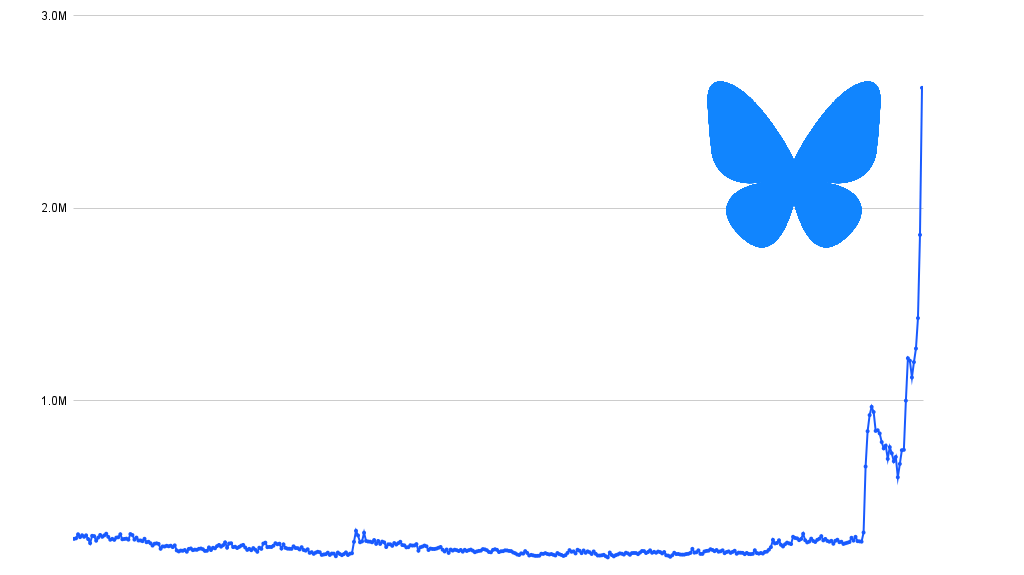
Since election day in the US, usage of the Bluesky app is more than 500% higher in the US and over 350% higher in the UK.
Bluesky, the social networking service originally created as a spin-off from Twitter, is seeing the most sustained growth since it emerged from an extended invite-only beta test period. The growth is linked to users either leaving X or investing more time in exploring a promising alternative.
As Techdirt editor and Bluesky board member Mike Masnick noted in a post, this burst of new users is shaping up to be different than any the service has seen previously. Before he joined the board, Masnick is the author of the paper credited with inspiring the creation of Bluesky, Protocols, Not Platforms: A Technological Approach to Free Speech.

The growth of Bluesky has been fueled by a rush of users either deactivating their accounts on X (see our blog post) or committing to use it less while exploring alternatives. Threads, the Meta Platforms alternative, is significantly bigger and also seeing strong growth, but the explosion of use of Bluesky in the US is more sudden and dramatic. The political dimension of the change is that X owner Elon Musk made himself an outspoken advocate for the candidacy of Donald Trump, although some users may be switching for various reasons such as changes in X’s algorithms and policies.
Bluesky and its user and developer communities have been actively encouraging the transition with mechanisms such as Starter Packs of recommended users to follow (searchable via blueskydirectory.com) and a Chrome extension that helps automatically map the accounts a user follows on X to their new home on Bluesky.
Here’s the dramatic uptick of daily active users of the app in the US …

… and for the UK.

In both the US and the UK, visits to the Bluesky website surged ahead of those for the Threads website, reflecting strong interest from potential new users.

Worldwide, the pattern looks different, particularly as measured by app daily active users (for Android, in this case), reflecting a huge influx of Brazilian users during the period when access to X was banned in that country. That increase was more than twice as big as the recent post-election surge (see detail below).

Worldwide, Bluesky didn’t quite surpass Threads in website daily visits in the days since the election, but it came close.

When using X was not an option for users in Brazil, many of them picked Bluesky over Threads as the substitute that was closest to the experience they were used to. After the government lifted its ban on X, usage dropped dramatically as X users returned to that platform. However, usage of Bluesky for the most recent week, at 1.4 million daily active users on Android, was still about 17 times higher than it was earlier this year.

At the moment, Bluesky is enjoying a virtuous cycle of rapidly increasing usage driving press coverage, which in turn drives more users to sign up and begin experimenting with Bluesky. The Washington Post headline Liberals are fleeing X again — this time for Bluesky explains part of this phenomenon. Political leanings aren’t the only reason to switch, however. Bluesky offers features some users find appealing, such as a decreased emphasis on algorithmically driven newsfeeds in favor of more personally created feeds of accounts to follow – and also shared lists of accounts worth blocking.
We will be watching to see if the strong upward trend for Bluesky that has persisted since the election proves lasting for the weeks and months to come.
The Similarweb Press Office can pull additional or updated data on request for the news media (write to press@similarweb.com). When citing our data, please reference Similarweb as the source and link back to this post.
Disclaimer: All names, brands, trademarks, and registered trademarks are the property of their respective owners. The data, reports, and other materials provided or made available by Similarweb consist of or include estimated metrics and digital insights generated by Similarweb using its proprietary algorithms, based on information collected by Similarweb from multiple sources using its advanced data methodologies. Similarweb shall not be responsible for the accuracy of such data, reports, and materials and shall have no liability for any decision by any third party based in whole or in part on such data, reports, and materials.

David covers social media, digital advertising, and generative AI. With a background in web trends since the 1990s, he’s also the author of "Social Collaboration for Dummies".
Give it a try or talk to our insights team — don’t worry, it’s free!