Where the Olympics News Drove the Most News Traffic
by David F. Carr4 Min.
Aug 14, 2024
 Insights
News stories that go viral on social media are not the traffic driver they used to be, even for buzzy publishers like Buzzfeed and Buzzfeed News (which just shut down) or Vice (which recently announced layoffs and programming cutbacks) – in fact, the organizations who were most successful in the past at driving traffic that way may be feeling the pain the most now.
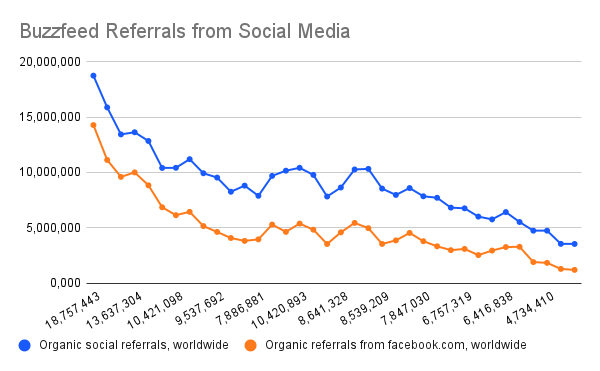
For the top 100 News and Media organizations Similarweb tracks, organic referrals from social networks were 55% lower in March 2023 than they were in April 2020. For Buzzfeed, that drop was 81% and for its smaller Buzzfeed News division it was 60%.
Buzzfeed was particularly known for driving traffic from Facebook, and there the news is even worse: with referral traffic down 92% for Buzzfeed and 85% for Buzzfeed News, both in comparison with Spring 2020.
How much of this change was driven by the evolution of social media algorithms versus the intense competition for consumer attention online is up for debate, but the change is real.
We saw a consistent pattern across the top 100 domains listed in Similarweb’s News and Media industry category.
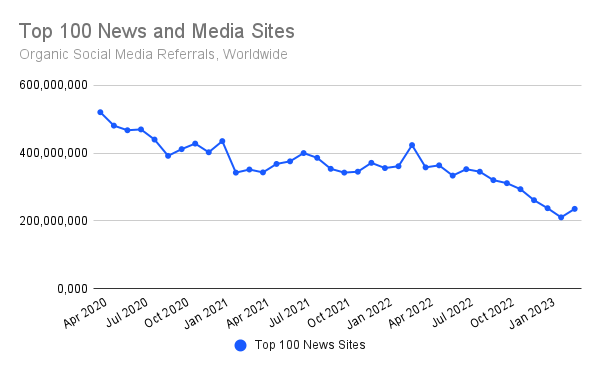
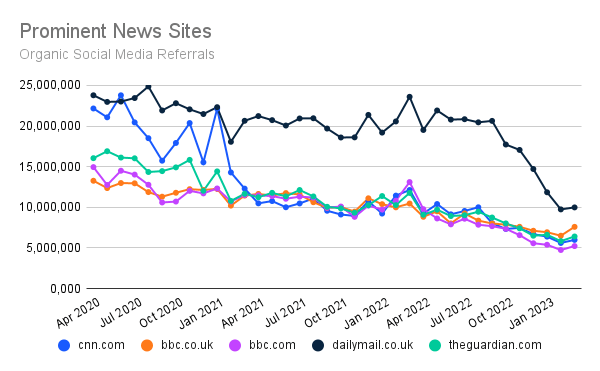
Major news sites were not immune to the trend, although not all were equally dependent on social referrals.
For example, here is the trend for nytimes.com …
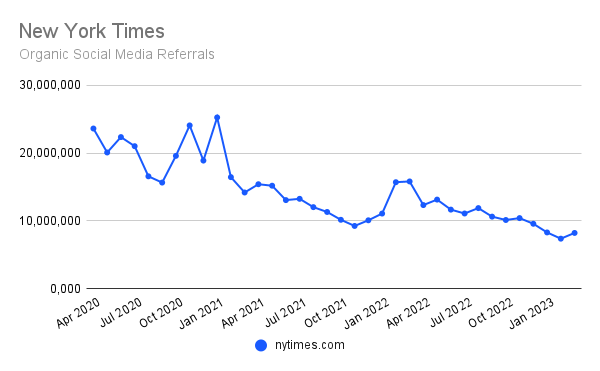
…. and for other global news organizations.
The Buzzfeed brands have seen a steep drop in total social media referrals and referrals from facebook.com in particular.
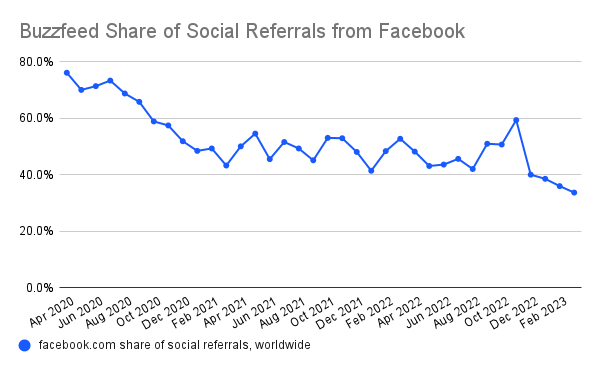
Buzzfeed’s share of social referrals coming from Facebook has also dropped, probably partly as the result of an effort to diversify into attracting links from other social networks.
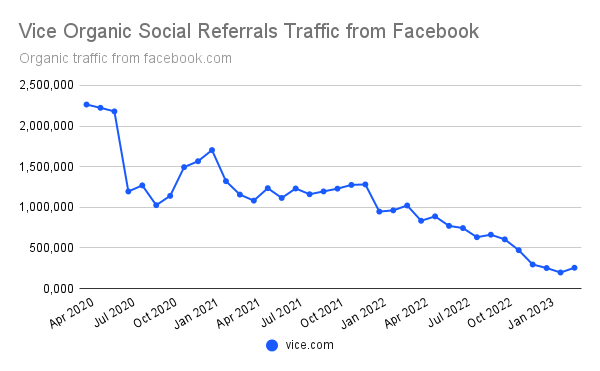
The story of declining referrals from Facebook is similar for Vice, where Facebook referrals are down 89% from 2020 levels and 75%, year over year.
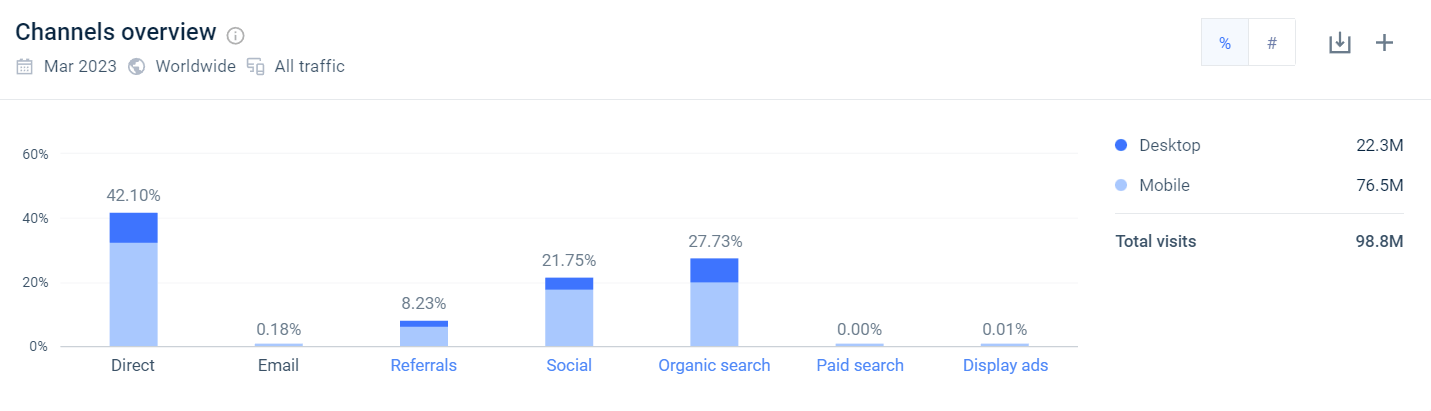
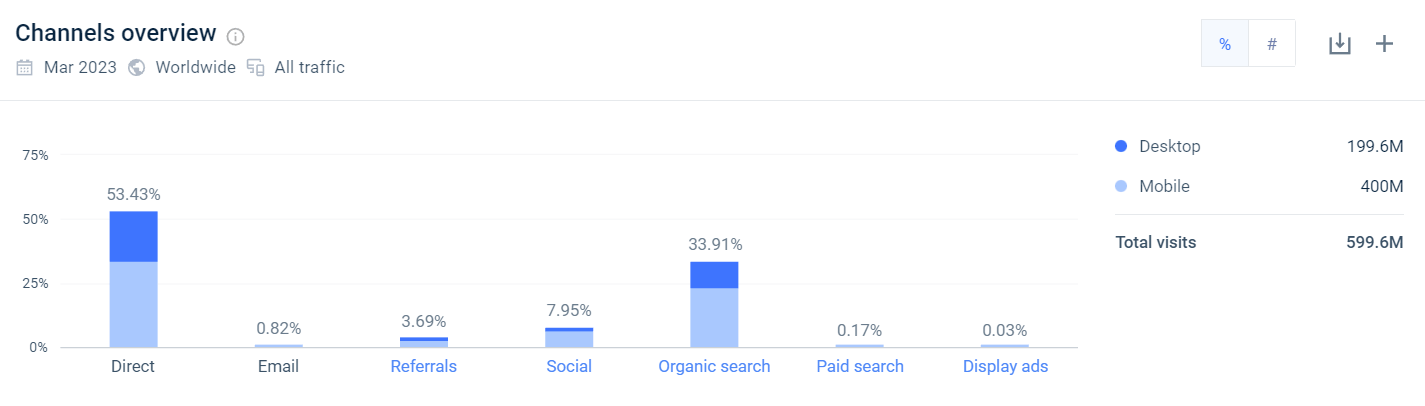
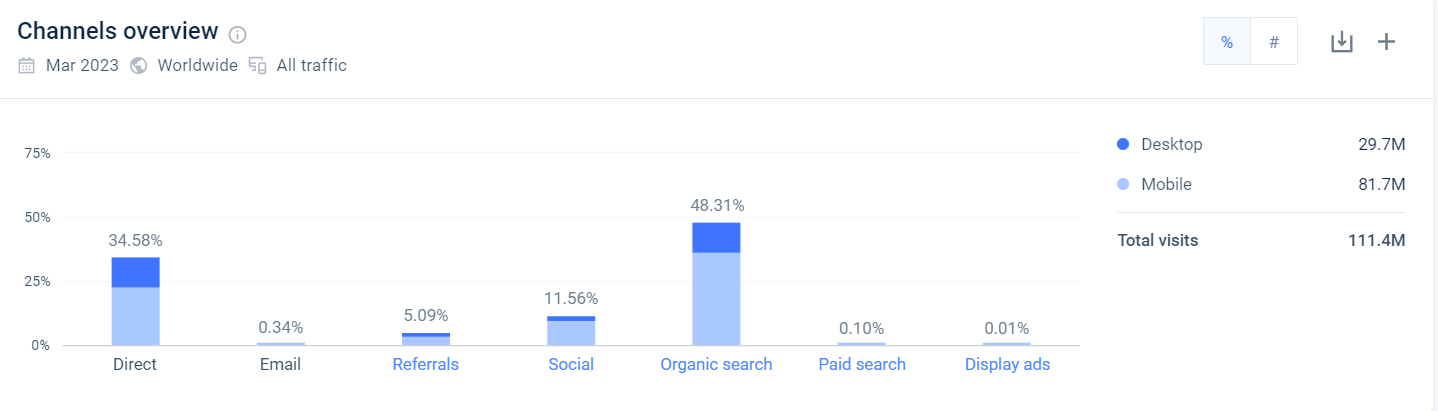
Social referrals accounted for 22% of the traffic to buzzfeed.com, versus 8% for nytimes.com, and 11.6% for npr.org, the National Public Radio website.
Here’s the breakdown for buzzfeed.com …
… nytimes.com
… and npr.org
Looking at social referrals to news sites also helps explain some other recent developments, such as NPR’s decision to stop engaging with Twitter after a dispute over being labeled “state-sponsored media.” Although Twitter is the leading social referral source for many other news organizations, for NPR it ranked third behind Facebook and Reddit – making it easier for NPR’s management to decide to walk away.
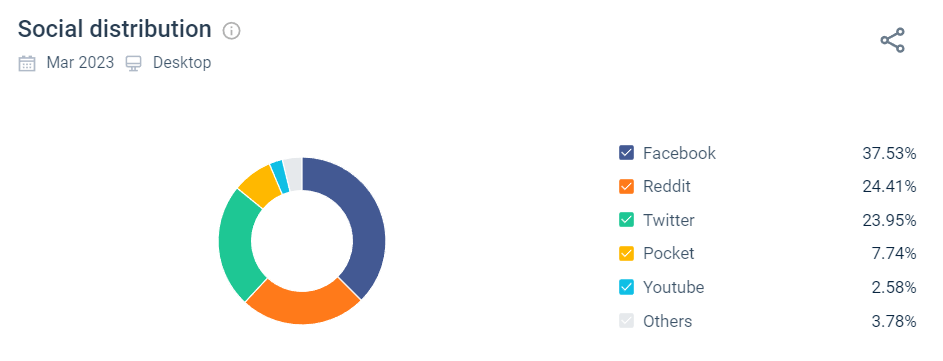
The relative lack of traffic from Twitter to NPR does not seem to be the result of any Elon Musk policy, as Twitter also ranked third among news social referral sources for NPR at the same time last year.
While making a story go viral on social media is still valuable, it’s not as valuable as getting readers in the habit of looking at your website every day or ranking high in search when people are looking for an authoritative story on a given subject.
The Similarweb Insights & Communications team is available to pull additional or updated data on request for the news media (journalists are invited to write to press@similarweb.com). When citing our data, please reference Similarweb as the source and link back to the most relevant blog post or similarweb.com/blog/insights/.
Contact: For more information, please write to press@similarweb.com.
Report By: David F. Carr, Senior Insights Manager
Disclaimer: All names, brands, trademarks, and registered trademarks are the property of their respective owners. The data, reports, and other materials provided or made available by Similarweb consist of or include estimated metrics and digital insights generated by Similarweb using its proprietary algorithms, based on information collected by Similarweb from multiple sources using its advanced data methodologies. Similarweb shall not be responsible for the accuracy of such data, reports, and materials and shall have no liability for any decision by any third party based in whole or in part on such data, reports, and materials.

David covers social media, digital advertising, and generative AI. With a background in web trends since the 1990s, he’s also the author of "Social Collaboration for Dummies".
Give it a try or talk to our insights team — don’t worry, it’s free!