




The Top 100 Most Visited Websites in the World (August 2026)
by Shai Belinsky10 Min.
Sep 17, 2026
 Sales Intelligence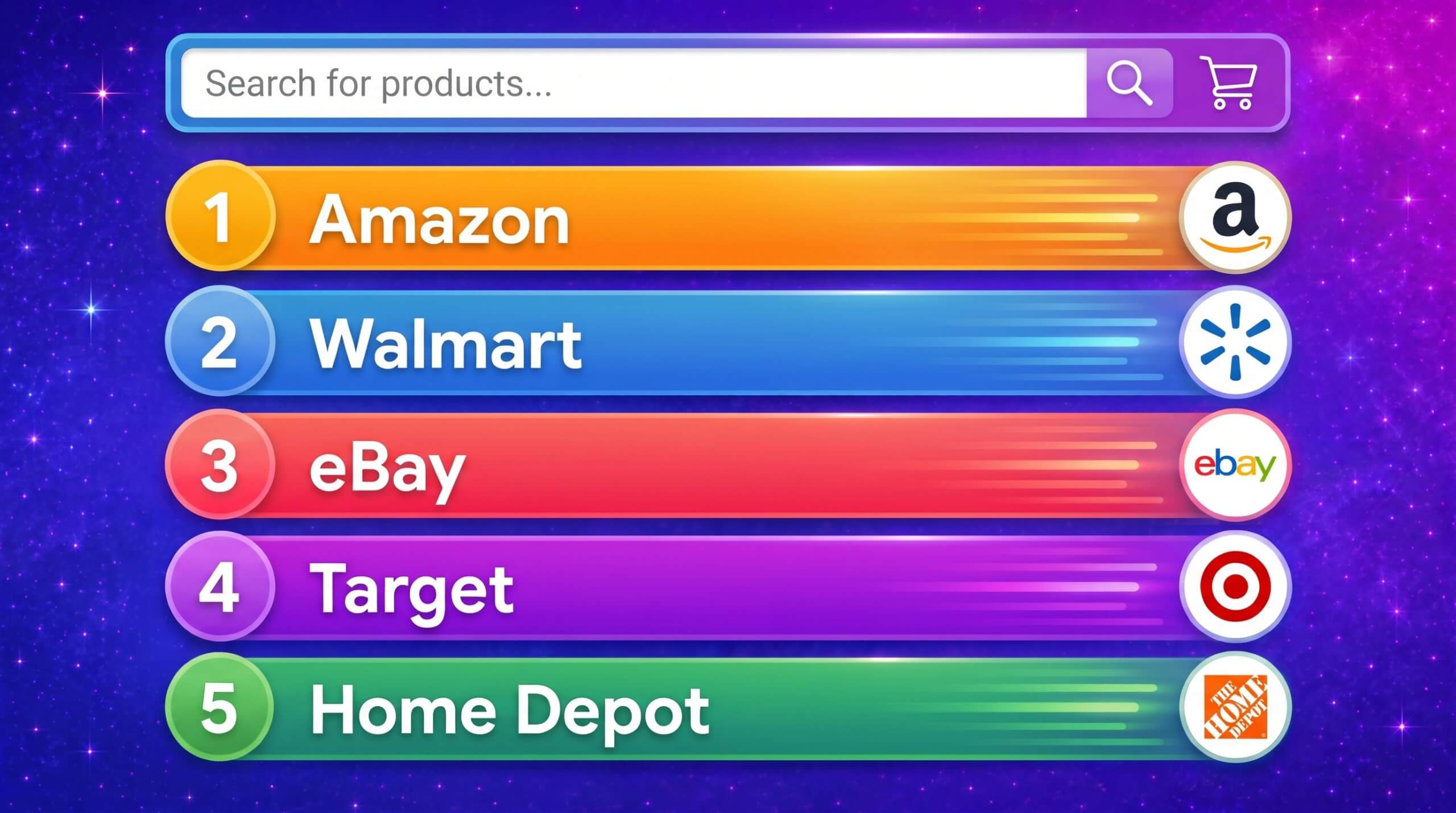
Selling to ecommerce companies? Then keep a close eye on the leaders.
That’s why we created and regularly update our list of the top 100 ecommerce companies in the US. We’ve got lists for the top ecommerce companies in the world and the top UK ecommerce companies, too. After all, selling to ecommerce starts with knowing exactly who is winning and why.
So, which ecommerce brands are leading in terms of website traffic in 2026? And what changed at the top?
First up, key themes from our data. Then you’ll find the top 15 US ecommerce companies with a closer look at each tier of the ranking, followed by the full downloadable top 100.
Similarweb data from 2026 shows four themes at the top of US ecommerce:
Amazon alone accounts for about 45% of all visits generated by the top 15 US ecommerce companies, and it pulls more traffic than the next nine companies on the list combined.
In our previous edition, eBay held second place. In our recent data, Walmart edges ahead with 573.5M monthly visits to eBay’s 551.9M, a gap of about 4%. The two are close enough that this race is far from settled.
eBay at number three attracts more than double the visits of Target at number four (551.9M vs. 244.2M). Everyone below the marketplace trio is competing in a different weight class.
Home Depot (228.1M) and Lowe’s (148.4M) together generate over 376M monthly visits, more than any single retailer outside the top three.
Here’s the 2026 top 15, ranked by monthly website visits, from the full downloadable list of the top 100 ecommerce companies in the United States:
| # | Domain | Monthly Visits | HQ country |
| 1 | amazon.com | 2,404,855,719 | United States |
| 2 | walmart.com | 573,482,615 | United States |
| 3 | ebay.com | 551,918,097 | United States |
| 4 | target.com | 244,158,515 | United States |
| 5 | homedepot.com | 228,132,938 | United States |
| 6 | apple.com | 205,965,743 | United States |
| 7 | lowes.com | 148,428,282 | United States |
| 8 | t-mobile.com | 132,137,828 | United States |
| 9 | nordstrom.com | 129,554,077 | United States |
| 10 | bestbuy.com | 120,250,917 | United States |
| 11 | wayfair.com | 118,528,175 | United States |
| 12 | gap.com | 116,373,046 | United States |
| 13 | att.com | 111,594,269 | United States |
| 14 | costco.com | 110,880,941 | United States |
| 15 | expedia.com | 99,595,198 | United States |
The downloadable list gives you the big-picture view of how these brands perform, so you can prioritize accounts, build territories, and spot buying signals before your competitors do.
The table answers “who”, Sales Intelligence answers “why”. Here’s what our recent data tells us about each tier of the top 15.
New ecommerce competitors emerge every year, but with 2.4B monthly visits in 2026, Amazon remains the category in a very real sense: it generates about 4.2x the traffic of second-place Walmart and captures roughly 45% of all visits across the top 15.
For sellers targeting the ecommerce ecosystem, that scale is the point. Amazon’s gravity defines the benchmarks every other retailer on this list measures itself against, which means every account below it is actively investing to close the gap. That investment is your opportunity.
The story of this edition: Walmart takes the number two spot with 573.5M monthly visits, moving ahead of eBay. Walmart’s omnichannel model, where store pickup, delivery, and marketplace expansion feed the same digital front door, continues to convert its physical footprint into web traffic.
eBay, one of the first companies to connect online buyers and sellers at scale, sits at 551.9M monthly visits. The margin between eBay and Walmart is about 21.6M visits, roughly 4%, so second place remains genuinely contested. eBay’s resale and collectibles positioning keeps it fundamentally different from the retail giants around it: nobody else on this list monetizes secondhand demand at anything close to this volume.
Target holds fourth with 244.2M monthly visits. It’s the first stop below the marketplace trio, and the drop is steep: Target attracts less than half of eBay’s traffic. That said, Target leads the “everything store, curated” tier comfortably, ahead of Home Depot and Apple.
Home Depot rounds out the top five with 228.1M monthly visits. Combined with Lowe’s at number seven, home improvement generates over 376M monthly visits inside the top 15, evidence that high-consideration, project-based shopping has fully moved online, even in a category where the product often weighs 50 pounds.
If you sell to these companies, the tier structure matters more than any single company’s spot on the list. Accounts in tight races (Walmart vs. eBay, Best Buy vs. Wayfair, Home Depot vs. Lowe’s) are the ones under the most competitive pressure, and competitive pressure is what opens budgets. Running an ecommerce competitor analysis on your target account’s closest rival is often the fastest way to build a first meeting that lands.
This list is a starting point, not a strategy. The teams that win ecommerce accounts use traffic data three ways:
A retailer climbing the rankings is investing; a retailer sliding is fixing. Both are triggers, but they call for different pitches.
The top three buy differently than 20 to 100. Match your ideal customer profile to the tier where your solution wins, not to the logos that look best on a slide.
Opening a conversation with a prospect’s own traffic trend, channel mix, or competitive gap changes the meeting from pitch to consultation. That’s exactly what Similarweb Sales Intelligence surfaces for each of the 100 companies on this list, alongside the best sales prospecting tools workflows to act on it.
The top 100 tells you who leads US ecommerce on traffic. What it can’t tell you on its own is which of these accounts is about to spend, and that’s the question that actually fills pipeline.
That answer lives one level deeper. Every company on this list generates signals month after month: traffic climbing or slipping, new marketing channels lighting up, technologies being added to or removed from the stack, engagement rising on key pages. A retailer whose visits are surging is scaling and buying tools to support growth. One losing ground to a rival in a tight race, like the Walmart and eBay contest at the top of this list, is under pressure to fix something, fast. Both are openings; each needs a different pitch.
Similarweb Sales Intelligence puts those signals next to every account, so instead of working the list top to bottom, you can sort it by opportunity: filter by traffic trend, technology, or engagement change, spot the accounts in motion, and walk into the first call with the prospect’s own data on the table.
If you want to pull ecommerce insights like these in seconds, book a demo to find out how Similarweb Sales Intelligence can help you uncover your ideal prospects, their tech setups, and their pain points for 2026.
Which is the biggest ecommerce company in the United States?
Amazon.com leads US ecommerce with 2.4B monthly visits in 2026, according to Similarweb data. That is roughly 4.2x the traffic of second-place Walmart.com and about 45% of all visits generated by the top 15 US ecommerce companies.
How does Similarweb rank the top ecommerce companies in the United States?
Similarweb lists companies by estimated monthly website traffic, filtered for genuine ecommerce retailers using website type classification and detected ecommerce technologies. The full methodology can be replicated in Similarweb Sales Intelligence.
Which ecommerce brands have the highest website traffic in 2026?
The top five US ecommerce brands by monthly visits in 2026 are Amazon.com (2.4B), Walmart.com (573.5M), eBay.com (551.9M), Target.com (244.2M), and Homedepot.com (228.1M).
Did the top ecommerce rankings change in 2026?
Yes. The most notable change in the 2026 data is Walmart overtaking eBay for second place, with 573.5M monthly visits to eBay’s 551.9M. Nordstrom also enters the top 10, and AT&T and Expedia join the top 15, reflecting how telecom device sales and travel booking now compete with traditional retail on traffic.
What criteria were used to build the top 100 US ecommerce companies list?
Three filters: Geography set to United States, Website Type set to Ecommerce, and Website Technologies limited to sites with detected ecommerce technologies. This ensures the domains ranked are true transactional ecommerce properties rather than content or brand sites.
How can I use the top 100 list to find B2B leads?
Download the full list or recreate it in Similarweb Sales Intelligence, then enrich each account with traffic trends, technology stack, and engagement data. Prioritize accounts showing digital momentum or competitive pressure, since both signal active investment and open budgets.

by Inbar Eytan
Product Marketing Manager
Inbar Eytan is the Product Marketing Manager for Sales Intelligence at Similarweb. With 8 years of experience in marketing, she believes in the power of turning data into actionable insights that make a real impact.
The Top 100 Most Visited Websites in the World (August 2026)

Most Searched Things on Google in 2026

3 of the Sharpest Minds Weigh in on the State of Gen AI in 2026
Try Similarweb Sales Intelligence today — free of charge

