

Anthropic IPO: What Claude's Web and App Data Show
by Kene Fidel-Ndubisi7 Min.
Sep 24, 2026
 Sales Intelligence
Picture this: you’ve spent three weeks researching a prospect, building a custom deck, and rehearsing your pitch. You get 12 minutes on the call before the VP interrupts with “We’re already working with [competitor]” and the meeting ends. Your carefully crafted pitch never made it past slide four.
This scenario plays out thousands of times daily because most sales pitches are built backward. They start with what you want to say rather than what the prospect needs to hear. The consultative sales approach flips this model: you demonstrate value by proving you understand the prospect’s market position before you ever mention your product.
Here’s the problem with traditional advice on creating a sales pitch: it treats every prospect as identical.
“Open with a hook, present your solution, close with urgency.” But 73% of B2B buyers actively avoid sellers who send irrelevant outreach. Generic pitches don’t just fail, they actively damage your brand’s reputation with prospects who might have bought from you under different circumstances.
This article introduces the PITCH framework, a research-first methodology for building sales pitches that earn trust before asking for commitment. You’ll learn how to map competitive landscapes that demonstrate market fluency, identify the specific data points that shift buyer perception, and structure your pitch so objections surface early when you can still address them. We’ll cover prospect research methodology, objection handling tactics that maintain momentum, and storytelling techniques that make your pitch memorable six months after the call ends.
A consultative sales pitch establishes credibility by demonstrating a deep understanding of the prospect’s competitive position before presenting any solution. This differs fundamentally from transactional pitching, where the seller leads with product features and hopes the prospect sees relevance.
The distinction matters because B2B buyers complete 57% of their purchase research before engaging a sales rep, and often more than 80% before they’ll take a meeting. By the time they take your call, they’ve already formed opinions about their problem and potential solutions.
A consultative approach acknowledges this reality: your job isn’t to educate them about their problem, it’s to prove you understand their specific version of that problem better than they articulated it themselves.
Consultative selling requires three proof points before you earn the right to pitch:
When you open a pitch with these three elements, you’re no longer a vendor trying to sell something. You’re a peer analyst who happens to have a solution. This shift in positioning is why consultative pitches convert at higher rates even when the underlying product is identical to what transactional sellers offer.
The Similarweb Sales Intelligence platform enables this consultative approach by providing the competitive benchmarking data you need before the first call. Instead of generic industry stats, you can show prospects exactly how their traffic sources compare to their top three competitors, which referral partners drive the most qualified traffic to competing sites, and where gaps exist in their current digital strategy.
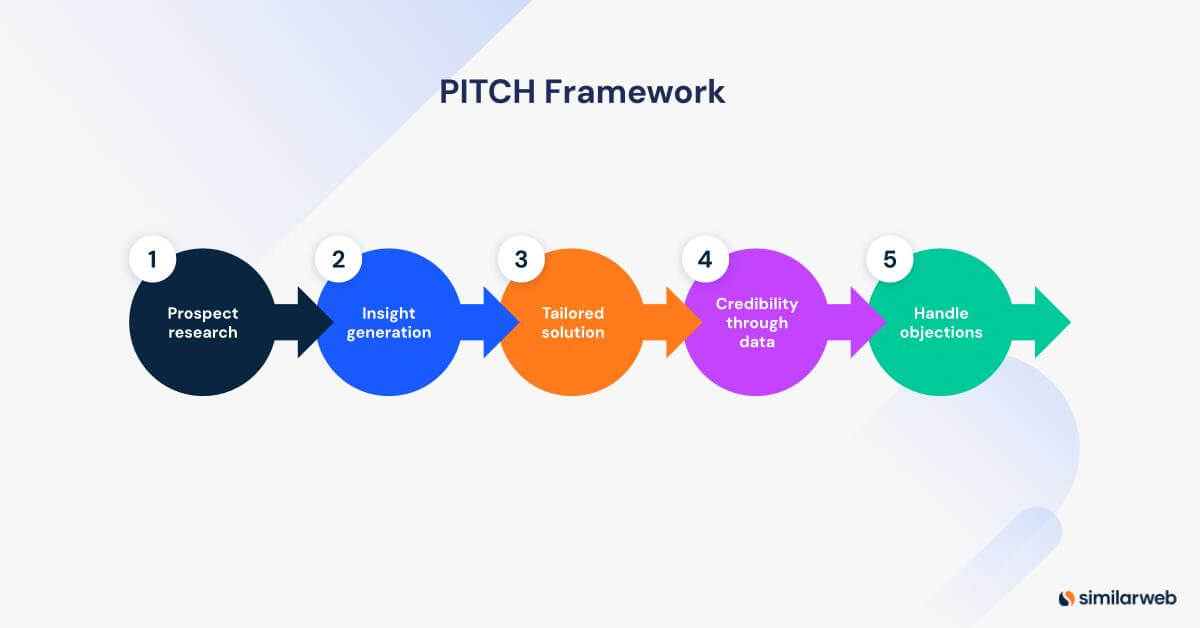
The PITCH framework structures your sales pitch around five sequential stages, each building credibility before moving to the next. This isn’t a script. It’s a logic model that ensures you earn the right to make claims before you make them.
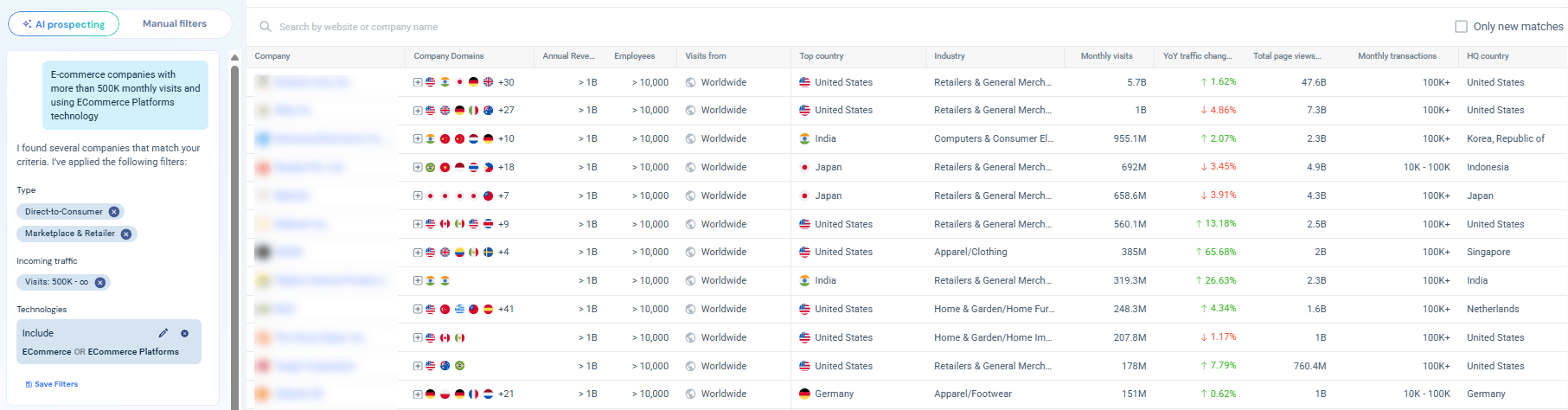
Before mapping the competitive landscape, you need the right account in your sights. The AI Prospecting Agent identifies and qualifies companies that match your ICP using a plain-language prompt, surfacing high-potential accounts from a dataset of 20M+ companies without manual list-building or filtering.
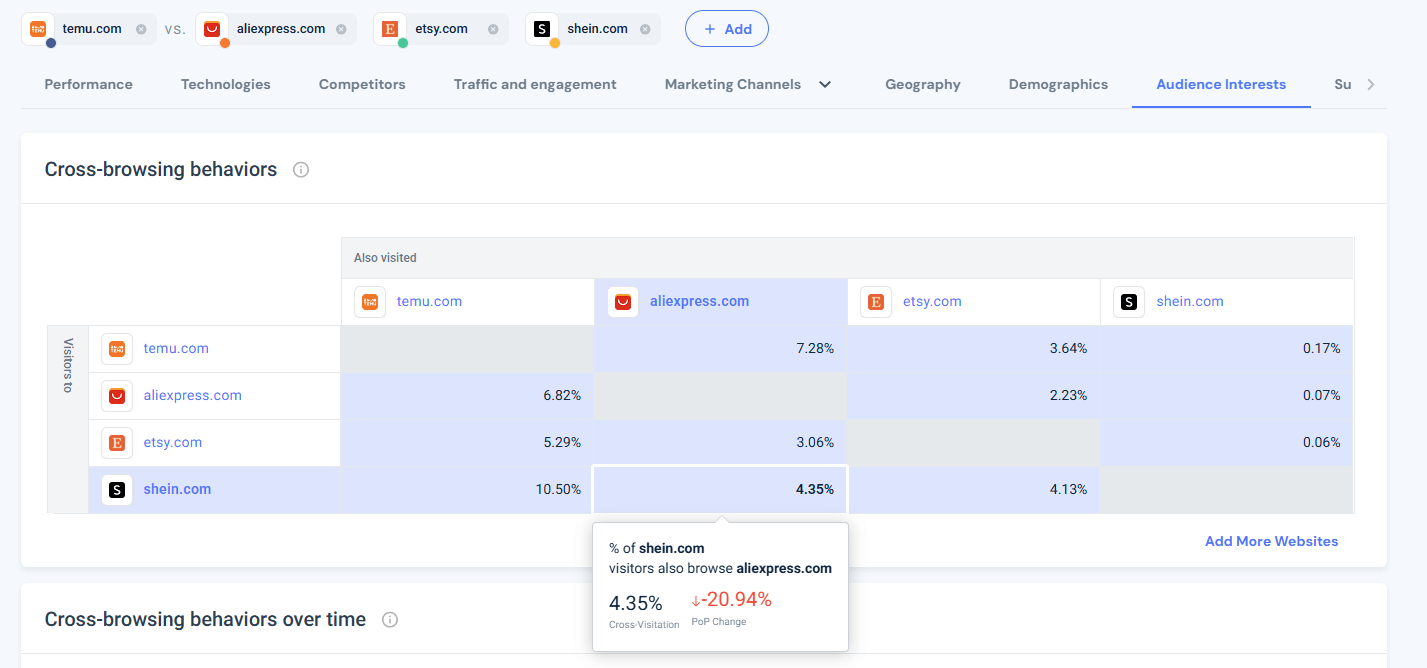
Start by defining the prospect’s competitive set using multiple methodologies. Category analysis reveals who competes in the same market segment. The Competitive analysis suite shows which sites share audience overlap. Audience interest analysis identifies where the prospect’s visitors go before and after visiting their site.
Cross-reference these three methods and filter for companies that match the prospect’s business model. For a specialty private-label apparel retailer, this means excluding multi-brand department stores even if they appear in the same category. The goal is a list of 5-8 true competitors that the prospect would recognize as peers.
Once you have the competitive set, check traffic and engagement metrics for each competitor. Calculate year-over-year growth rates to identify which competitors are gaining share. Measure bounce rates and pages per visit to assess engagement quality. This data becomes the foundation for every claim you make in the pitch.
With competitive data in hand, identify specific gaps between the prospect and top performers. These gaps must be quantifiable and actionable: “your bounce rate is 8 percentage points higher than the category leader” is useful, “your site could be better” is not.
Focus on three gap types:
Traffic source imbalances. If competitors receive 25% of traffic from referral partners while your prospect gets 8%, that’s a growth opportunity you can quantify. Calculate the traffic volume gap and translate it into potential revenue using industry conversion benchmarks.
Engagement quality differences. When competitors achieve 15% lower bounce rates or 40% longer session durations, these metrics indicate better product-market fit or superior site experience. Identify which specific site elements or content types drive the engagement gap.
Channel underinvestment. If top performers allocate 18% of traffic acquisition to paid search while your prospect invests 6%, you’ve found a strategic gap. But don’t stop at the percentage, go on to identify which specific keywords or ad formats competitors use that your prospect doesn’t.
Each insight needs a “so what” statement that connects the gap to business impact. “Competitor X gets 40% more referral traffic” is a fact. “Competitor X’s referral strategy delivers an estimated 12,000 additional monthly visitors, which at a 2.3% conversion rate represents $276,000 in additional monthly revenue” is an insight that justifies action.
Similarweb’s Value Selling tool automates this translation, turning raw competitive gaps into dollar-value business cases the prospect can take to their CFO.
Only after establishing market fluency and identifying specific gaps do you introduce your solution. But even here, the consultative approach differs from traditional pitching: you position your product as the tool that closes the specific gaps you’ve already proven exist.
Structure your solution presentation around the three gaps you identified. For each gap, follow this sequence:
This structure prevents the most common pitch failure mode: leading with features the prospect doesn’t yet understand they need. When you’ve already established that referral traffic is 17 percentage points below category leaders, introducing your affiliate partnership tools becomes the obvious next step rather than an unsolicited product pitch.
Consultative pitches differentiate on data quality, not just data quantity. Every competitor can cite industry reports. Only you can show the prospect their actual competitive position using Similarweb’s cross-device behavioral data.
Include at least one proprietary data point that the prospect cannot verify elsewhere. This might be:
When you present proprietary data, briefly explain the methodology. “This traffic estimate comes from Similarweb’s panel and clickstream data across 100 million devices, adjusted for category-specific patterns we’ve observed across 500+ similar retailers.”
This transparency builds trust while reinforcing that you have access to intelligence competitors cannot replicate.
The final stage of the PITCH framework addresses objections proactively rather than reactively. In consultative selling, objections aren’t obstacles. They’re buying signals that indicate the prospect is seriously evaluating your solution.
The most effective way to reduce cold objections is to time them. Buyer Intent and Signals data identifies when a prospect is actively searching for solutions like yours, so you enter the conversation at the moment of maximum receptivity rather than interrupting a cold inbox.
Research shows that 60% of buyers say no at least four times before saying yes. This means objection handling directly impacts your close rate. The key is to surface objections early in the pitch, when you still have time to address them, rather than waiting for them to emerge during the close.
Build objection handling into your pitch structure by asking direct questions after each major claim:
These questions accomplish two goals. First, they surface objections while you still have the prospect’s attention and can address them with data. Second, they demonstrate confidence. You’re not afraid of pushback because you’ve already validated your claims with research.
When objections do surface, use the “anchor in their numbers” technique. Instead of defending your product generically, reframe the objection using the prospect’s own competitive data.
If they say, “we’ve tried referral partnerships before, and they didn’t work,” respond with: “The data shows your current referral traffic is 8% of total traffic while category leaders average 23%. That suggests the partnerships you tried weren’t the right fit, not that the channel doesn’t work. Let me show you which specific referral sources drive qualified traffic for your top three competitors.”
The full objection handling system, including the listen-question-anchor technique and responses to the four most common objections, is covered in the section below.
Effective prospect research follows a structured progression from broad market context to specific competitive positioning to individual decision-maker priorities. Each layer informs the next, building a complete picture of where the prospect stands and what they need to hear.
Start by establishing whether the prospect is growing, declining, or flat within their category. Pull 12-month traffic trends and calculate year-over-year growth rates. Compare the prospect’s growth rate to category averages to determine relative performance.
This matters because the growth trajectory determines pitch strategy. A prospect growing 15% year-over-year in a flat category needs a different pitch than one declining 8% in a growing category.
The first wants to accelerate momentum, the second needs to stop the bleeding. Your pitch must acknowledge which situation applies.
Use Similarweb’s Web Intelligence to benchmark the prospect against category leaders. Identify the top 5 sites by traffic volume, then calculate each site’s growth rate. This reveals whether the category is consolidating around a few winners or fragmenting across many players. Consolidating categories demands aggressive competitive differentiation, while fragmenting categories rewards niche positioning.
Once you understand category positioning, analyze how the prospect acquires traffic compared to top performers. Break down traffic sources into seven categories: direct, organic search, paid search, gen-ai, social, referral, and email. Calculate the percentage distribution for both the prospect and their top three competitors.
Look for imbalances of 10+ percentage points in any single channel. These represent either strategic choices or missed opportunities. A prospect with 65% direct traffic and 5% referral traffic has made a conscious decision to prioritize brand building over partnership development, or they’ve simply never invested in referral strategies and don’t know what they’re missing.
For each significant channel gap, identify the specific tactics competitors use that the prospect doesn’t. If competitors receive 18% of traffic from referral sources, drill down to see which specific referring domains drive that traffic. Are they working with deal aggregators like Slickdeals? Content publishers like Refinery29? Influencer networks like RewardStyle?
Each partnership type requires different relationship-building approaches and delivers different audience quality.
Add buyer intent signals to this analysis to understand timing, not just gaps. Knowing a prospect’s channel mix tells you where competitors invest. Knowing when prospects in that category are actively searching for solutions tells you when to act on that intelligence.
The final research layer focuses on the individual decision-makers you’ll pitch. This isn’t about finding their favorite sports team for small talk, it’s about understanding their professional priorities and pain points so you can tailor your pitch to what they care about most.
Start with LinkedIn to identify their role, tenure, and recent activity. A CMO who joined six months ago has different priorities than one who’s been in the role for four years. The new CMO needs quick wins to establish credibility, and the tenured CMO can invest in long-term strategic shifts.
Your pitch must acknowledge which situation applies.
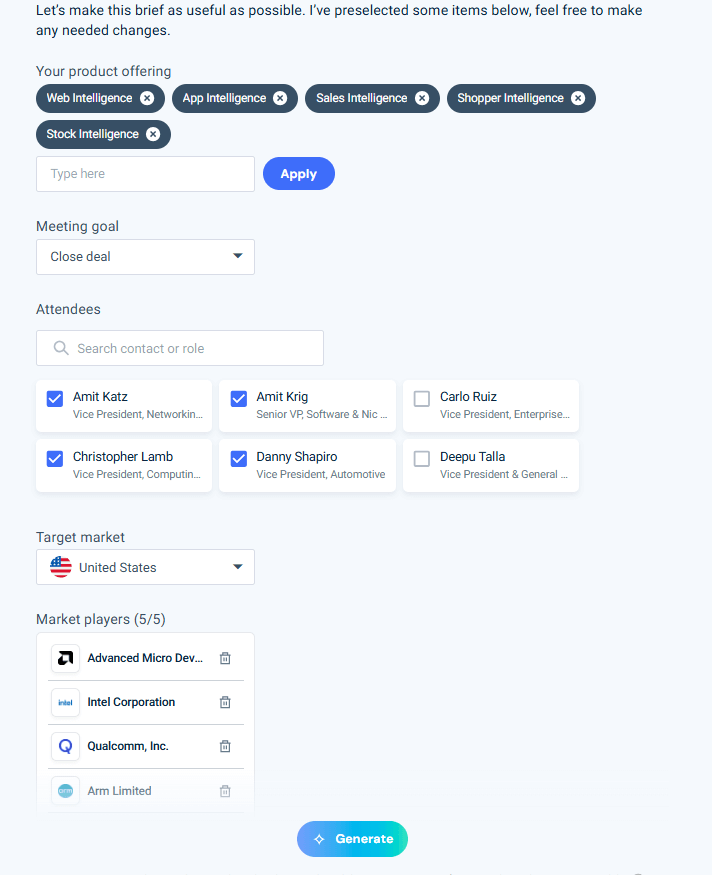
The AI Meeting Prep Agent consolidates this decision-maker research automatically, generating per-attendee analysis alongside the competitive brief so you walk in knowing not just what the company needs, but exactly who in the room you need to convince and how.
Look for public statements about their priorities. Conference presentations, podcast interviews, and LinkedIn posts often reveal what keeps them up at night.
If the VP of Sales recently posted about improving lead quality, your pitch should emphasize how competitive intelligence helps sales teams prioritize high-intent prospects, rather than generic benefits like market share visibility.
Create multiple pitch versions tailored to different types of decision-makers. A CFO cares about ROI and payback period. A VP of Marketing cares about competitive differentiation and brand positioning. A Head of Sales cares about pipeline velocity and win rates. The core data remains the same, but the framing and emphasis shift based on what each role values.
Objection handling in consultative selling means addressing concerns in a way that deepens the conversation rather than derailing it. The goal isn’t to “overcome” objections, it’s to use them as opportunities to demonstrate a deeper understanding of the prospect’s situation.
When an objection surfaces, resist the urge to immediately defend your solution. Instead, follow this three-step sequence:
This technique works because it shifts the objection from opinion (“partnerships are expensive”) to math (“partnerships cost less than what you’re doing now”). Math-based objections are easier to resolve because both parties can agree on the numbers even if they initially disagreed on the strategy.
“We don’t have a budget for this right now.” This objection usually means “I don’t see enough value to justify the cost.”
Respond by quantifying the cost of inaction using their competitive gaps. “Your traffic declined 8% last year while category leaders grew 12%. That 20-point gap represents approximately $2.4M in lost revenue opportunity. The question isn’t whether you can afford this investment, it’s whether you can afford to fall further behind while competitors accelerate.”
“We need to see more proof that this works.” Translate this as “I don’t trust that your case studies apply to my situation.”
Respond with case studies from companies that match the prospect’s profile as closely as possible. “Here’s a specialty apparel retailer with similar traffic volume and competitive position. They implemented the referral strategy we discussed and increased referral traffic from 6% to 19% over eight months, generating an incremental 8,500 monthly visitors at 40% lower CPA than paid channels.”
“This seems too complex to implement.” This objection signals concern about internal resources and change management.
Respond by breaking the implementation into phases and showing quick wins. “The full strategy spans 12 months, but we can start with the three highest-impact referral partnerships we identified. Those three alone would close 40% of your traffic gap and require only one part-time resource to manage. We’ve seen clients generate positive ROI within 90 days using this phased approach.”
“We’re already working with [competitor].” This is often a brush-off rather than a real objection, but treat it seriously.
Respond by acknowledging the existing relationship while highlighting specific gaps your solution addresses. “That’s a solid platform for [specific use case]. Where we see clients add Similarweb is for cross-device traffic estimation and competitive benchmarking at scale. Your current tool likely provides your own metrics, but can it show how your referral strategy compares with your top five competitors using the same methodology? That’s the intelligence gap we fill.”
Not every objection is worth addressing. Some signal fundamental misalignment between what you offer and what the prospect needs. Learn to recognize these terminal objections:
When you encounter a terminal objection, acknowledge it directly and offer to reconnect when circumstances change. “It sounds like competitive intelligence isn’t a priority right now. I’ll follow up in six months to see if that’s shifted.” This preserves the relationship while avoiding the trap of trying to convince someone who isn’t ready to buy.
Stories make data sticky. A prospect might forget your traffic analysis, but they’ll remember the story about how a similar company used that analysis to identify a $3M revenue opportunity. Effective sales storytelling follows specific structural patterns that maximize retention and persuasion.
Structure your case studies using the classic hero’s journey framework, adapted for B2B sales:
The hero (your past client): Introduce a client in the same industry or a similar situation as your prospect. Use their actual company name if you have permission, or describe them specifically enough for the prospect to recognize the parallel. “A specialty apparel retailer with $50M in annual revenue and 8% year-over-year traffic decline” is far more relatable than “a retail client.”
The challenge: Describe the specific problem they faced, using quantified metrics. “They were losing market share to three fast-growing competitors. Their referral traffic had stagnated at 6% of total traffic while category leaders averaged 22%. They’d tried building partnerships with deal sites, but those partnerships delivered high-bounce, low-converting traffic.”
The guide (your solution): Position your product as the tool that enabled the hero to overcome their challenge. “We used Similarweb’s competitive analysis to identify which specific referral sources drove qualified traffic to their competitors. Instead of generic deal sites, we found that their top competitors partnered with niche fashion bloggers and style influencers who delivered 3x higher engagement rates.”
The transformation: Show the specific results they achieved, with before-and-after metrics. “Over eight months, they increased referral traffic from 6% to 19% of total traffic. More importantly, referral visitors showed 40% higher engagement than paid search visitors and converted at 2.8x the rate. This generated an incremental $2.1M in annual revenue at 60% lower customer acquisition cost than their previous paid strategy.”
The new reality: End with where the client is now and what they’re focused on next. “Today, referral partnerships are their primary growth channel. They’ve expanded from 8 partners to 23 and are now exploring international partnerships using the same methodology.”
This structure works because it mirrors how your prospect thinks about their own situation. They see themselves as the hero facing a challenge. Your product is the guide that helps them transform. The story provides a mental model for how they could achieve similar results.
Contrast is the most powerful storytelling device for sales pitches because it highlights the gap between the current state and the possible future state. Structure your pitch around three key contrasts:
Before vs. after. Show the client’s situation before and after implementing your solution, using specific metrics. “Before: 6% referral traffic, $47 paid search CPA, 8% year-over-year decline. After: 19% referral traffic, $18 blended CPA, 12% year-over-year growth.”
Prospect vs. competitors. Contrast the prospect’s current performance against category leaders. “You’re generating 8% of traffic from referrals. Your top three competitors average 23%. That 15-point gap represents approximately 9,500 monthly visitors you’re not capturing.”
Action vs. inaction. Contrast what happens if the prospect implements your solution with what happens if they maintain their current approach. “If you implement this referral strategy, our models suggest you’ll close 60% of the traffic gap within 12 months, generating an estimated $1.8M in incremental revenue. If you maintain your current strategy, the gap will likely widen as competitors continue investing in partnerships while you focus on paid channels with rising CPAs.”
These contrasts create cognitive tension that motivates action. The prospect can’t unhear the gap between where they are and where they could be.
Static case studies are persuasive, but real-time data about the prospect’s own competitive position is irresistible. Weave live competitive intelligence into your story as you tell it.
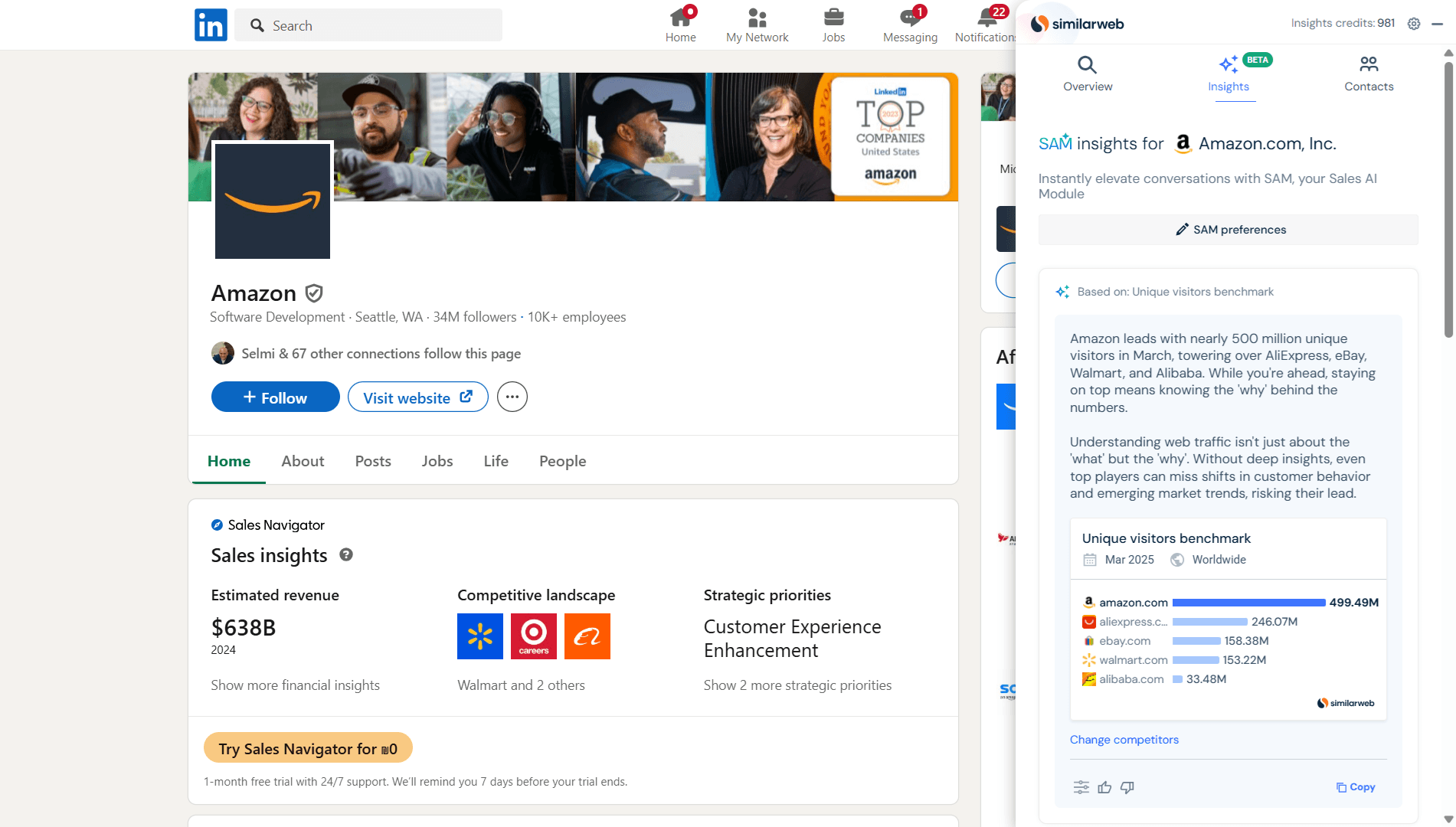
“Let me show you something interesting about your top competitor. [Pull up Similarweb data.] They’re currently receiving 4,200 monthly visits from RewardStyle, a fashion influencer network. That’s up 180% from six months ago, which suggests they recently expanded their influencer partnerships. Now look at your referral sources. [Switch to prospect’s data.] You’re not working with RewardStyle at all. This is exactly the type of gap we help clients identify and close.”
This technique transforms your pitch from a presentation into a live analysis session. The prospect isn’t passively listening to your story. They’re actively discovering insights about their competitive position alongside you.
This collaborative discovery process builds buy-in far more effectively than one-way storytelling.
The Company Research tool in Sales Intelligence makes this live demonstration possible from a single view: traffic trends, referral source rankings, technographics, and competitive benchmarks are all accessible without switching apps or building a custom report.
Every stage of the PITCH framework requires data that your competitors don’t have access to. Similarweb’s Sales Intelligence platform provides that data and the AI agents to turn it into action, covering the full arc from prospect identification to the moment you walk into the room.
Before you research a single account, the AI Prospecting Agent identifies and qualifies companies that match your ICP based on a plain-language prompt, surfacing high-potential accounts from a dataset of 20M+ companies. No manual list-building. No guesswork on fit.
Once you have your target list, Buyer Intent and Signals data tell you when a prospect is actively in-market for solutions like yours, and they refresh continuously, so you reach out at the moment of maximum receptivity rather than into a cold inbox.
These signals feed directly into the three-layer research methodology described above.
When it’s time to build the competitive brief that powers your P, I, and C stages, the AI Meeting Prep Agent generates a consultancy-style briefing in seconds: company overview, per-attendee analysis, channel mix, competitive landscape matrix, and growth opportunities drawn from Similarweb’s traffic, firmographic, and technographic data. What used to take 30+ minutes of manual research becomes a single click.
The AI Outreach Agent handles pre-meeting personalization, crafting account-specific messages grounded in real digital signals rather than generic templates. It integrates with Salesforce, HubSpot, Salesloft, and LinkedIn, so your outreach carries the same data-backed credibility as the pitch itself.
Underlying all of it is the Value Selling framework: the ability to quantify the gap between where a prospect stands and where category leaders operate, and translate that gap into a business case the prospect can take to their CFO.
The data comes from behavioral signals across 100M+ websites, refreshed daily and continuously for intent signals, so every number you put in front of a prospect reflects their current competitive reality, not last quarter’s.
Building a successful sales pitch in 2026 is less about perfecting a script and more about earning credibility before you make your ask. The PITCH framework gives sales teams a repeatable, research-first approach to consultative selling: one that leads with competitive intelligence, closes gaps with data, and earns trust by demonstrating market fluency from the first minute of the call.
What is the difference between a consultative and a transactional sales pitch?
A transactional pitch leads with product features and hopes the prospect sees relevance. A consultative pitch leads with the prospect’s competitive position before mentioning any solution. The difference is sequence: consultative sellers demonstrate market fluency first, proving they understand the prospect’s specific version of the problem better than the prospect articulated it themselves.
What is the PITCH framework for building a sales pitch?
PITCH is a five-stage consultative selling framework: Prospect research to map the competitive landscape, Insight generation from quantified competitive gaps, Tailored positioning that ties your solution to those gaps, Credibility through proprietary data the prospect cannot verify elsewhere, and proactive objection Handling before objections derail momentum. Each stage earns you the right to present the next one.
How do you tailor a sales pitch to different types of decision-makers?
Lead with the business outcome each role cares about most. CFOs need ROI and payback period. VPs of Marketing want competitive differentiation. Heads of Sales focus on pipeline velocity. Keep the underlying competitive data consistent across versions and shift only the framing. Use the AI Meeting Prep Agent to generate per-attendee analysis before the call.
How do you handle objections during a sales pitch without losing momentum?
Use the listen-question-anchor technique. Listen completely without interrupting, ask clarifying questions to find the real concern, then anchor your response in the prospect’s own competitive data. This reframes the objection from opinion to math. Since 60% of buyers say no at least 4 times before saying yes, surfacing objections early, while you still have data to address them, is critical.
Why do most sales pitches fail to close deals, and how can you avoid these mistakes?
Most pitches fail because they lead with the product rather than the prospect’s competitive reality. The fix is to demonstrate market fluency before mentioning your solution: name their top three competitors, explain their category trajectory, and identify one thing competitors are doing that you are not. That shift converts you from vendor to peer analyst, and peer analysts get to keep talking.
What storytelling techniques make your sales pitch more memorable and persuasive?
Structure case studies as a five-part hero’s journey: a relatable client, their quantified challenge, your solution as the guide, a before-and-after transformation, and where they are now. Pair it with three contrast structures: before-vs.-after metrics, prospect-vs.-competitor benchmarks, and action vs. inaction projections. Reinforce both with live competitive data pulled during the call.
How do you create a compelling opening hook that captures attention in the first 30 seconds?
Open with a scenario that the prospect will immediately recognize as their own. Describe their competitive situation with enough specificity that they assume you have been watching their business. The article’s opening serves as a model: a prepared rep loses a call in 12 minutes because they led with product rather than competitive insight. That level of market fluency earns you the right to keep talking.
What research should you conduct about your prospect before delivering your pitch?
Follow the three-layer methodology. Layer 1 establishes category positioning and growth trajectory, which determines your entire pitch angle. Layer 2 analyzes traffic sources across seven channels to identify competitive gaps. Layer 3 researches individual decision-makers: role, tenure, and stated priorities. Use the AI Prospecting Agent to confirm ICP fit, and the AI Meeting Prep Agent to automatically consolidate Layer 3.

by Inbar Eytan
Product Marketing Manager
Inbar Eytan is the Product Marketing Manager for Sales Intelligence at Similarweb. With 8 years of experience in marketing, she believes in the power of turning data into actionable insights that make a real impact.
Try Similarweb Sales Intelligence today — free of charge