




The Top 100 Most Visited Websites in the USA (August 2026)
by Shai Belinsky10 Min.
Sep 29, 2026
 Marketing Intelligence
If you’ve ever wondered why some sites consistently outrank you despite having similar content, website authority is usually part of the answer. Recent findings from the 2024 Search API leak suggest that Google may use internal sitewide authority signals, reinforcing what SEOs have suspected for years.
When I look at why certain sites consistently dominate their SERP niches while technically sound competitors stall out, website authority is almost always part of the explanation. It’s not the whole picture, but it’s a reliable signal of whether Google trusts your domain enough to send it traffic at scale.
This guide explains what domain authority actually measures, what a good score looks like in 2026, where they fit in an AI search world, and the strategies that move the number for real.
Website authority is a score, scaled 1–100, that predicts how likely a website is to rank in Google compared with competing sites. The score reflects the strength of a domain’s link profile and overall content reputation, sites with more high-quality referring domains tend to score higher, because each editorial link counts as a vote of confidence from a third party.
The inputs it rewards link quality, content depth, brand search demand, and topical coverage, are the same signals Google measures internally through its own sitewide authority system.
One thing worth knowing: authority is logarithmic, not linear. Moving from 20 to 30 takes far less effort than moving from 60 to 70, and the curve gets steeper the closer you climb to 100. The headline number matters less than how you stack up against the sites you actually compete with on the SERP.
No, not directly. Google does not use any third-party website authority metric as a ranking input. But Google does run its own internal sitewide authority signal, which the 2024 API leak partly exposed. Website authority scores from tools like Similarweb are therefore useful proxies, not direct inputs to ranking.
Google’s John Mueller has repeatedly stated that Google does not use third-party authority metrics when crawling, indexing, or ranking pages. Search Engine Land also notes that metrics like Domain Authority are proprietary SEO-tool estimates designed to predict ranking strength, not signals used directly by Google’s algorithm.
The practical takeaway: focus less on the score itself and more on the underlying signals that influence it, high-quality backlinks, topical depth, brand visibility, and overall site trust.
Different tools calculate website authority using their own proprietary models, but the inputs are consistent across all of them: referring domain count, total backlinks, link quality, anchor text diversity, and spam signals.
Similarweb provides two key authority metrics inside its backlink analysis tools: Domain Score and Backlink Influence.
Domain Score is a standardized 0–100 score that evaluates the overall trustworthiness and authority of a referring domain. Domains closer to 100 typically carry stronger SEO authority and ranking influence.
Backlink Influence measures the SEO value passed through an individual backlink. The score evaluates how authoritative and impactful a linking page is, helping identify which backlinks are likely to pass meaningful ranking signals.
Together, these metrics help SEO teams evaluate both the overall strength of a domain and the quality of the links pointing to it.
Even though Google doesn’t directly use it, website authority remains a high-signal proxy for how Google ranks your site against competitors. A higher score correlates with stronger link equity, broader topical coverage, and brand recognition, all inputs that Google measures internally.
The top-ranked page for a given query has, on average, 3.8 times more referring domains than pages ranked lower in the top 10. Referring domain diversity remains the third-most-important ranking signal in the same 2025 analysis, behind content relevance and on-page topical depth.
Three reasons the metric still earns its place in SEO reporting:
The risk is treating the score as a ranking outcome rather than a planning input.
When I want to evaluate a site’s authority, whether it’s my own domain or a competitor’s, I start inside Similarweb’s Backlink Analysis tool. The goal isn’t just to look at a single score, but to understand the strength, consistency, and quality of the domain’s backlink profile over time.
Navigate to Similarweb’s Backlink Analysis tool and enter any domain. The overview dashboard surfaces the core authority signals immediately: total referring domains, backlinks, and the domain authority.
More importantly, the charts below show how referring domains and backlinks have changed over time, which helps distinguish stable authority growth from temporary spikes.
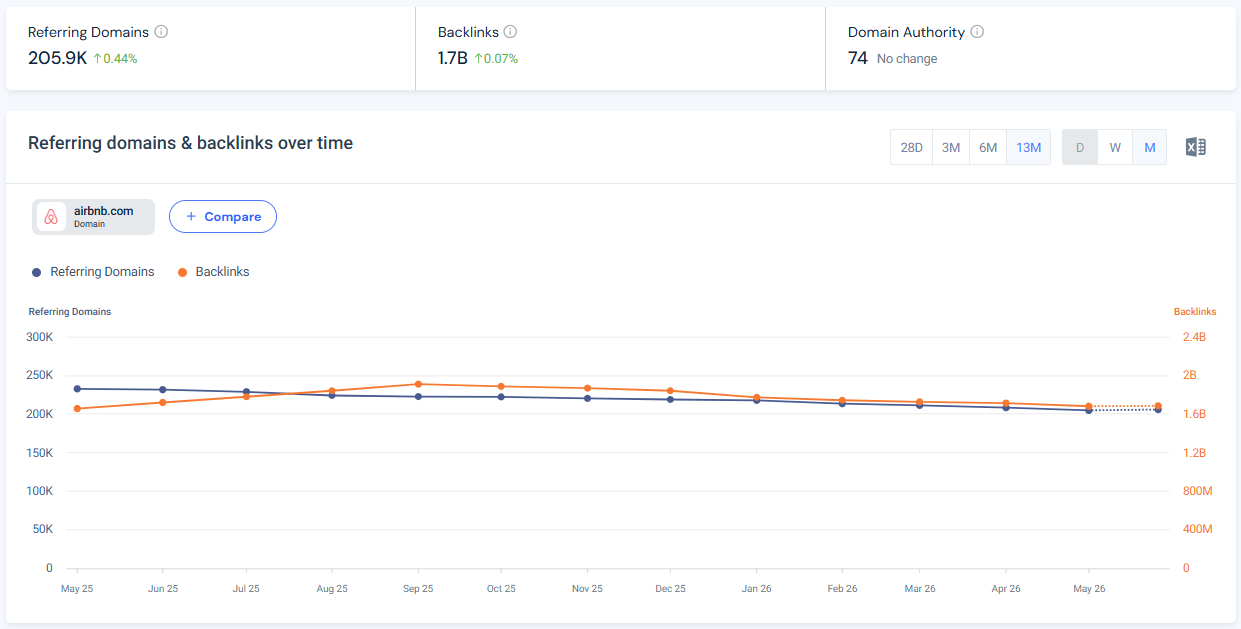
A standalone authority score rarely tells the full story. A domain with a Domain Score of 45 that has steadily gained referring domains over 12 months is usually in a stronger position than a domain sitting at 60 but consistently losing links.
The “Referring domains & backlinks over time” chart helps identify whether authority is compounding or decaying. Pair that with the “New vs. Lost” view to understand link acquisition velocity and churn.
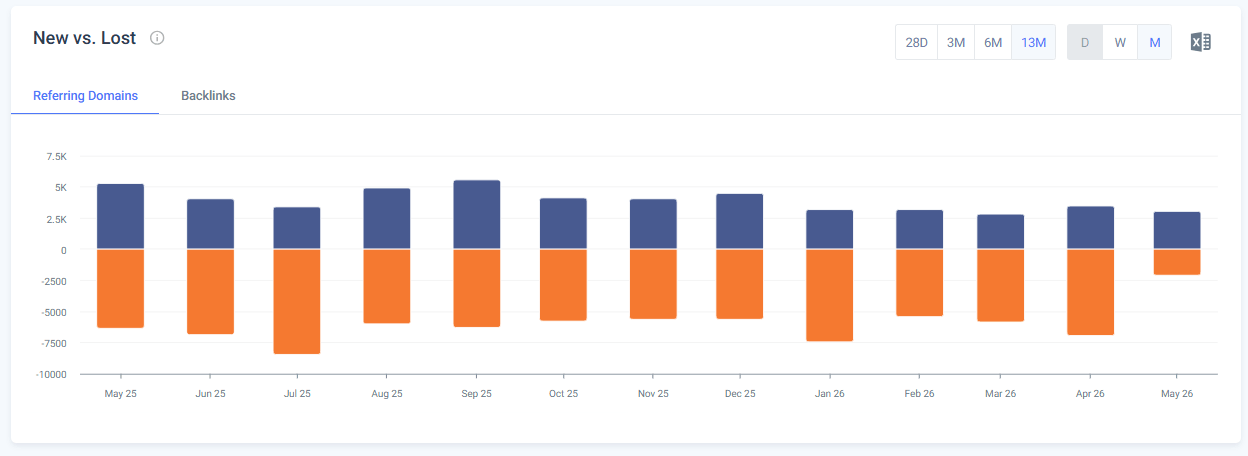
When evaluating authority, I usually look for:
Those patterns tend to correlate much more strongly with sustainable rankings than a single snapshot metric.
Authority is heavily influenced by the quality of the domains linking to you, not just the quantity. Inside the referring domains table, Similarweb lets you sort and filter linking domains by domain authority, backlink volume, and follow/nofollow status.
This is where you can identify whether a site’s authority comes from credible editorial sources or from inflated low-quality links.
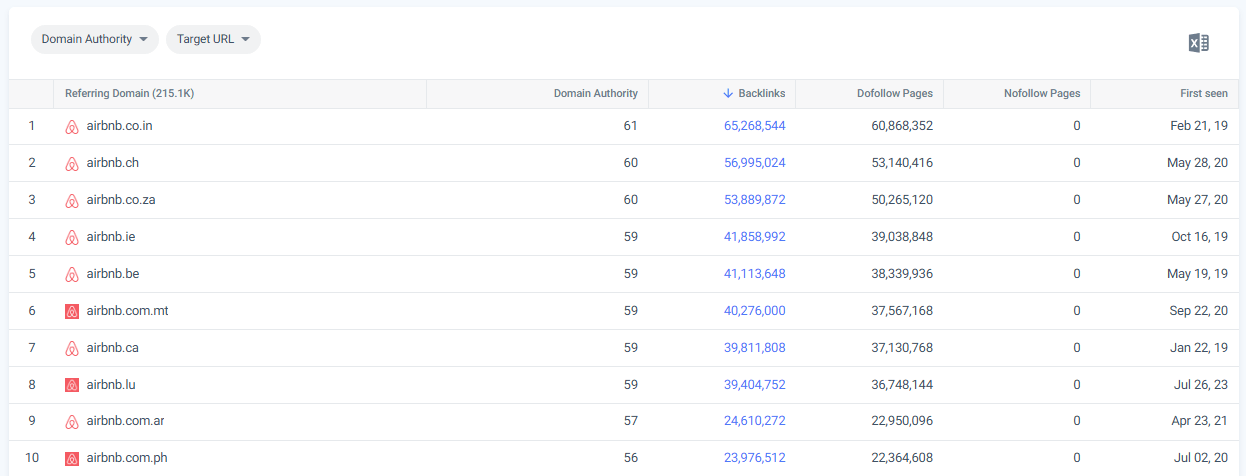
A backlink profile supported by trusted, high-authority domains will generally outperform a larger but weaker profile built from low-trust sites.
After reviewing domain-level signals, drill down into the backlink-level data. Similarweb’s backlink table includes both Backlink Influence and Domain Score, which help evaluate how much authority individual links may pass.
Backlink Influence estimates the SEO value of a specific backlink, while Domain Score reflects the authority of the referring domain itself.
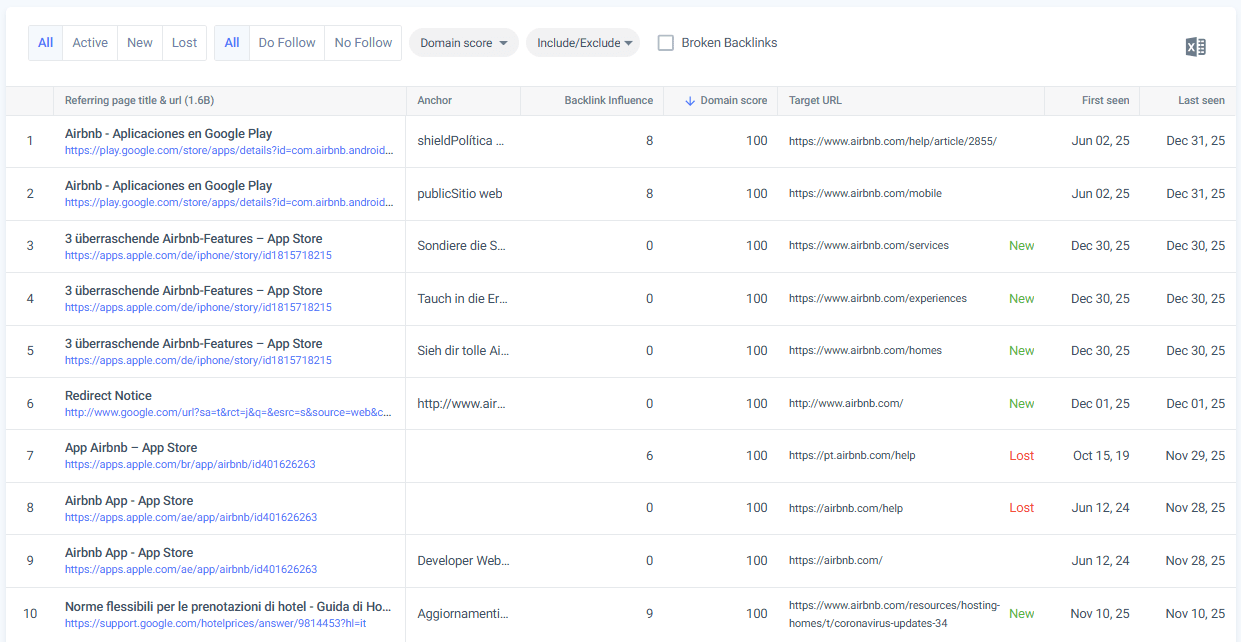
This layer is critical because not all backlinks contribute equally. A handful of editorial links from authoritative domains can drive significantly more ranking value than thousands of low-quality directory or spam links.
In practice, the most useful authority analysis combines:
That combination gives a far more accurate view of ranking strength than any single score alone.
A good website authority score is whatever score beats your direct organic competitors for your target keywords. There is no universal threshold. The general industry framing breaks down like this:
| Domain Score Range | What it typically means |
| 1–20 | New or thin sites. Most domains live here. |
| 21–40 | Established sites with some link equity. |
| 41–60 | Strong domains that compete in most non-elite niches. |
| 61–80 | Major brands and large publishers. |
| 81–100 | Internet-scale sites (top news publishers, platforms). |
In practice, the number only matters relative to the sites competing for the same SERP positions. A Domain Score of 35 may be enough to rank in a low-competition niche, while highly competitive verticals like finance, SaaS, or travel often require significantly stronger authority profiles.
It’s also important to remember that authority compounds over time. Domains that consistently earn high-quality backlinks, expand topical coverage, and build brand recognition tend to increase their ranking potential steadily, even if the score itself moves slowly.
Instead of chasing an arbitrary benchmark, compare your site against the domains already ranking for your target keywords. If your authority gap is large, focus first on narrowing the difference through stronger content, higher-quality backlinks, and broader topical depth.
AI search has not killed website authority. If anything, AI engines lean harder on authority signals when selecting which sources to cite, because they have no equivalent of a SERP click to validate quality. High-authority domains end up cited disproportionately in ChatGPT, Perplexity, Gemini, and Google’s AI Overview.
Two shifts matter for authority-building in 2026:
A single citation in an Overview can be worth multiple traditional rankings. Website authority is one of the strongest predictors of whether an AI engine picks your page as a citation source.
AI engines tend to cite domains with strong backlink reputations, deep topical coverage, and high content density on the query subject.
The practical implication: an authority-building program that historically targeted Google rankings now drives visibility across both traditional and AI surfaces. The work compounds, but the measurement model has to widen to track citations and AI referral traffic alongside SERP positions.
For an AI-search-specific layer on top of website authority, see how to build a topical authority system for AEO, which structures content depth around the entity and sub-topic graph that AI engines extract.
The fastest way to move website authority is to fix the underlying inputs the model rewards: referring domain diversity, link quality, content depth, and brand search demand. The modern scoring model filters low-quality and AI-generated links, so volume tactics no longer work.
Five high-leverage moves drive almost all real authority gains.
Editorial backlinks are still the strongest website authority signal. What works in my experience:
Topical depth signals to Google, and to AI engines selecting citations, that your domain owns a subject area, not just a page. Website authority compounds when interlinked content covers a subject end to end.
Practical pattern: pick a hub topic, map every sub-query, build content for each, and interlink them through descriptive anchors. A topical map approach gives the structural starting point.
Internal links pass authority between pages, surface deep content for crawlers, and tell search engines which pages matter. Sites with thin internal linking leak authority. Sites with a flat, well-linked architecture distribute it.
Three internal-linking rules that actually move the metric:
Technical SEO does not directly raise website authority, but technical decay drops it. Slow pages, broken redirects, and indexation failures reduce the share of your link equity Google can actually use to rank pages.
Similarweb’s site audit tool flags high-impact technical issues, crawl errors, broken internal links, redirect loops, schema gaps, that quietly cap authority transfer across the domain.
Website authority is only meaningful relative to competition. Pull your Domain Score and your top five organic competitors’ scores every quarter. Track the gap, not the absolute number.
A competitive analysis platform, combined with a structured SEO competitive research process, gives visibility into competitors’ link-acquisition velocity, content publishing cadence, and keyword expansion. If the gap widens, your authority program is under-resourced. If it narrows, the program is working, even if the absolute score is not yet where you want it.
Website authority remains a useful shorthand for ranking strength in 2026, even as Google’s own systems and AI engines reshape how authority is measured and surfaced. The underlying inputs that drive it, editorial backlinks, topical depth, brand search demand, technical health, are the same inputs Google’s internal authority signals reward.
The teams that move website authority deliberately treat it as the visible output of an underlying program, not as the goal itself. They build links from sources that journalists and AI engines trust, cover topics end to end, audit their technical foundation, and benchmark against the specific competitive set they need to beat. That is the work the score reflects, and it is the work that compounds.
What is the difference between website authority and domain authority?
Website authority and domain authority refer to the same concept: a score that estimates how likely a domain is to rank in Google based on factors like backlink quality, topical relevance, and brand signals. Different SEO platforms use different terminology, Similarweb uses the metric name Domain Score to measure overall domain authority and trustworthiness.
Is website authority a Google ranking factor?
No. Google has repeatedly stated it does not use third-party website authority metrics for crawling, indexing, or ranking. Google does use its own internal sitewide authority signal (called “siteAuthority” in the 2024 API leak), which evaluates similar inputs but is not publicly visible.
What is a good website authority score in 2026?
A good score is one that beats your top organic competitors for your target keywords. In general, a Domain Score of 40+ puts you ahead of the majority of indexed domains. By industry, B2B SaaS/marketing averages 66, finance averages 75, and construction or legal services average 53–55 to rank on page one.
How do I check my website authority with Similarweb?
Use Similarweb’s Backlink Analysis tool. Enter any domain to see its Domain Score, referring domain count, and a 12-month trend line. Then run the same query for your top 5 organic competitors to benchmark the gap, that gap is more useful than any absolute score.
How long does it take to improve website authority?
Expect 6–12 months of consistent work to move authority by a measurable amount on an established site, longer on a new domain. The metric updates monthly, but the underlying link and content signals it tracks compound over years. Quick spikes are usually scoring artifacts that revert within a few cycles.
Do social media links improve website authority?
Not directly. Social platforms add the nofollow attribute to outbound links, so they do not pass authority equity. They influence the metric indirectly by amplifying content that earns editorial links from other sites and by driving branded search demand, which is itself a Google authority input.
How does website authority relate to AI search visibility?
Strongly. AI engines like ChatGPT, Perplexity, Gemini, and Google’s AI Overview lean on domain-level authority signals when selecting which sources to cite. Domains with strong link profiles and deep topical coverage get cited disproportionately in AI-generated answers, which converts into measurable referral traffic from AI surfaces.
What is the difference between Domain Score and Backlink Influence?
Similarweb’s Domain Score metric evaluates the overall trustworthiness and ranking strength of a domain on a 0–100 scale. Backlink Influence measures the SEO value passed through a specific backlink, helping identify which links are likely to contribute the most authority and ranking impact.

Senior SEO Specialist at Similarweb
Maayan is a senior SEO specialist with 7+ years of experience in SEO. She loves complex research projects, creating SEO strategies and performing technical audits.
The Top 100 Most Visited Websites in the USA (August 2026)
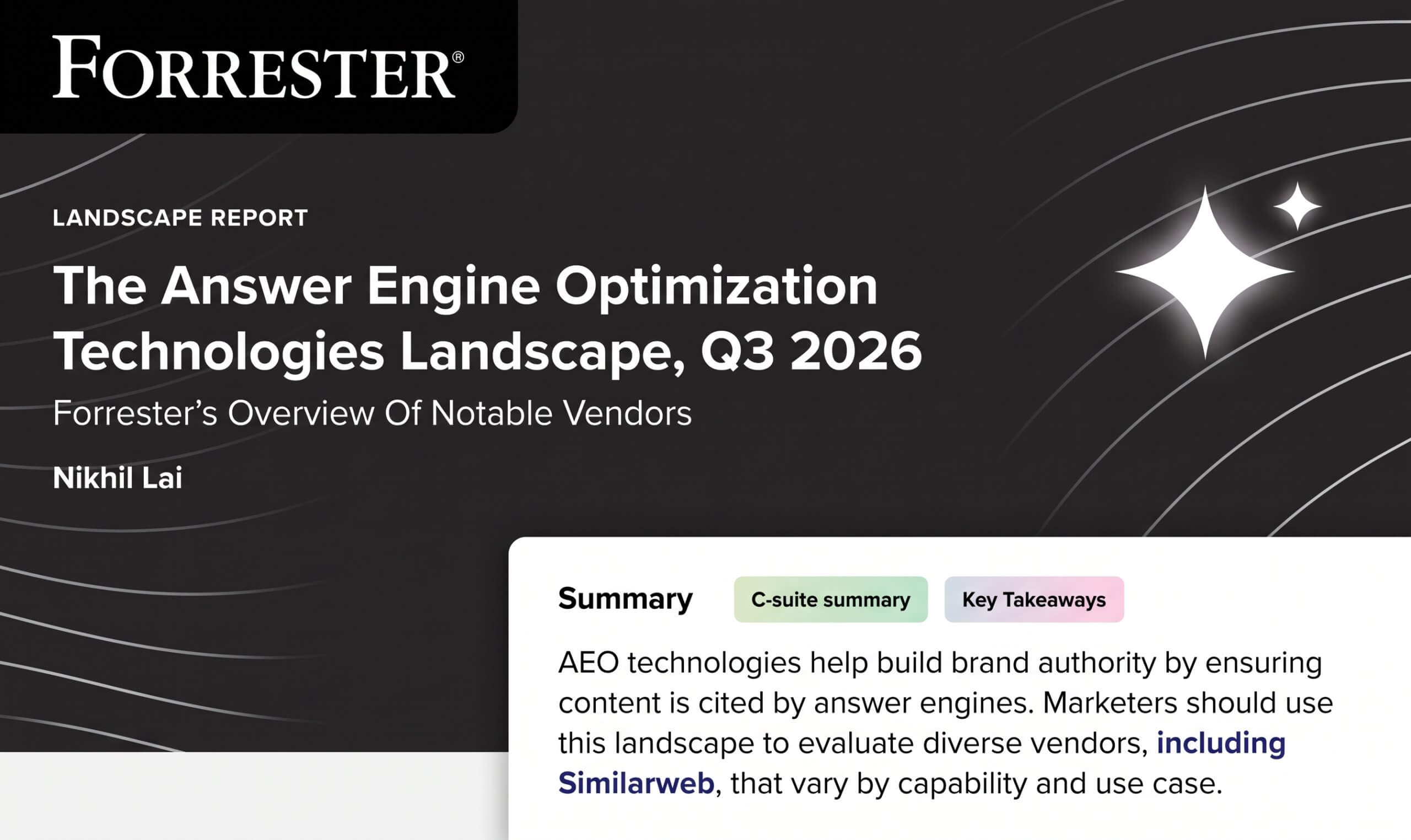
Similarweb Named in Forrester's Answer Engine Optimization Technologies Landscape, Q3 2026

Anthropic IPO: What Claude's Web and App Data Show
Give it a try or talk to our marketing team - it’s free!
